AI visibility score
The single number most AI visibility tools lead with. Here is how it should be calculated, what the tiers mean, and when a change is real.
By the Surfacedd teamUpdated 4 min readMarkdown
On this page
Short answer
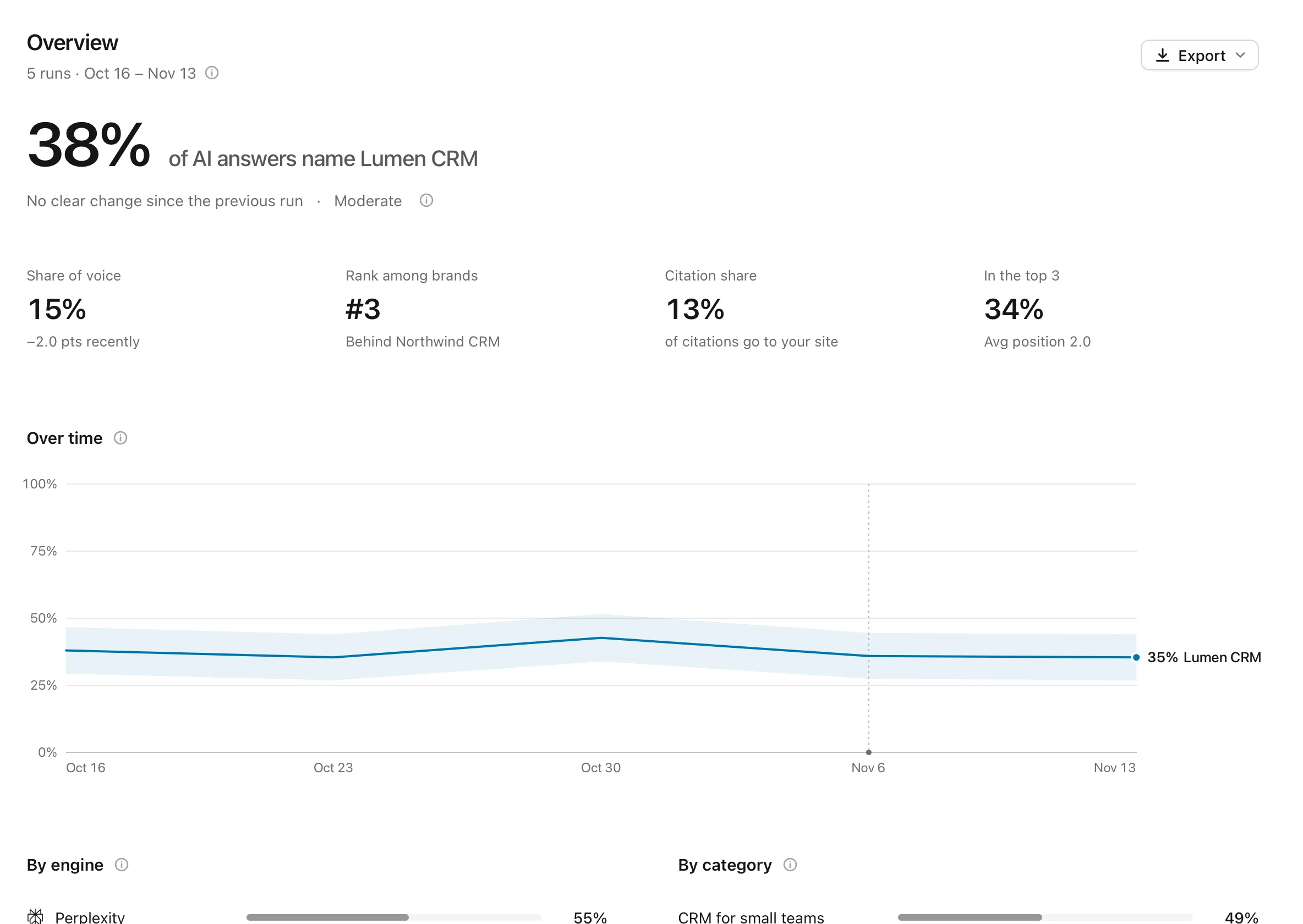
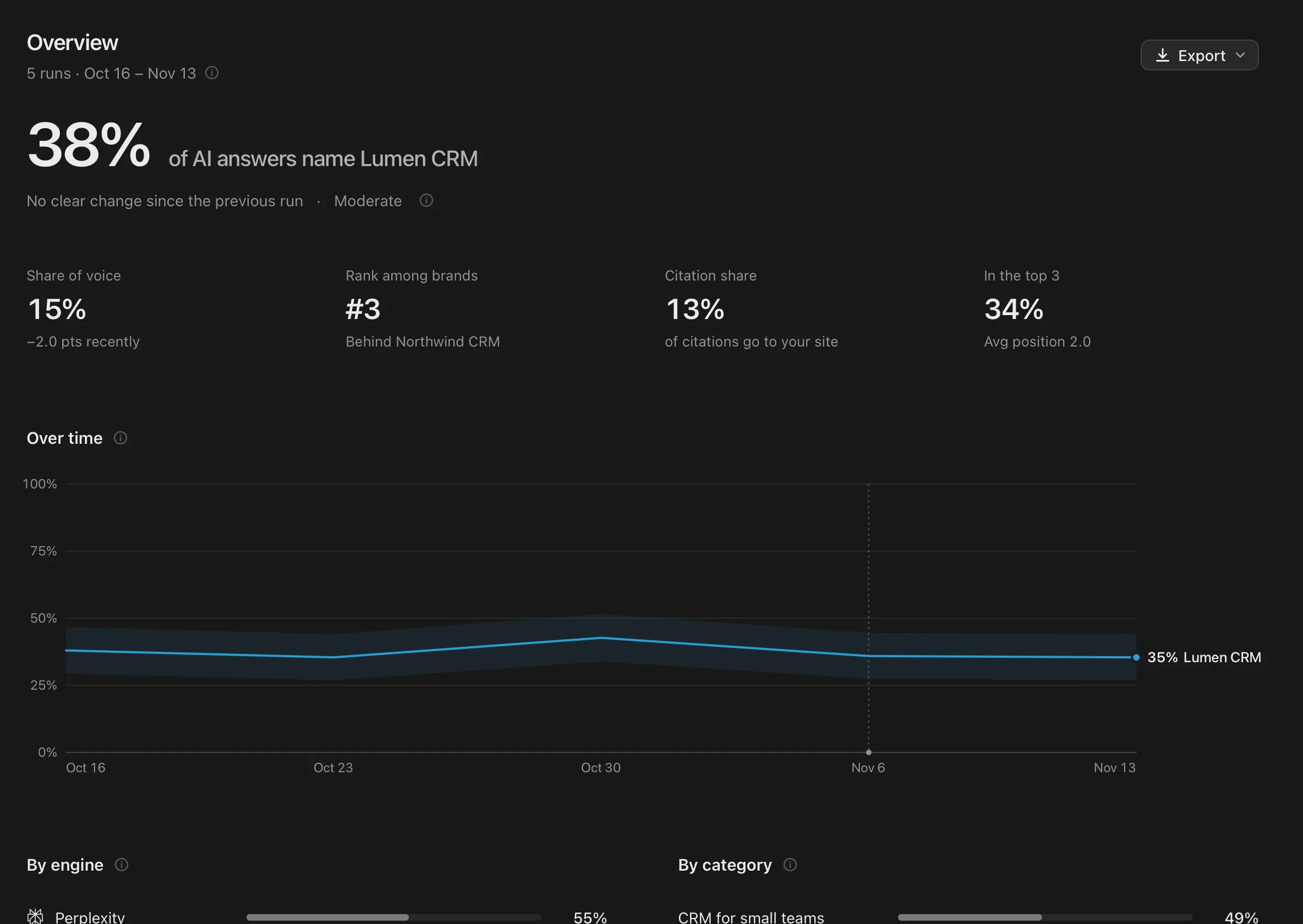
An AI visibility score is the percentage of AI answers, across a fixed set of prompts and engines, that name your brand. In Surfacedd it is answers naming you divided by all answers in view, so 30 of 80 answers is 38%, shown with its count, a 95% range and a tier: Strong, Moderate or Emerging.
Definition
An AI visibility score is the share of AI-generated answers that name your brand, measured over a defined set of prompts, engines, markets and dates. If you ask 20 buyer questions on 4 engines and 30 of the 80 answers mention you, your score is 38%.
It is the headline metric of AI search tracking because it answers the plainest question a marketer has: when people ask AI assistants about my category, how often do I come up? For the wider concept, including position, citations and sentiment, see the guide on what AI visibility is. This page covers the number itself.
The formula
visibility = answers that name the brand ÷ all answers in scope
Three details decide whether the number means anything:
- Every answer weighs the same. A long answer that names you five times counts once. A prompt you sampled three times counts three times.
- "Naming" needs a rule. In Surfacedd an answer names you if your name or an alias appears in the answer text, or the text contains a link to your own domain. A link that appears only in the engine's source list does not count: that is a citation, measured separately.
- The scope is fixed. The prompts, engines, markets and models must be the same from run to run, or a change in the score may come from the setup rather than from the AI.
Some tools publish a blended 0–100 index that mixes mentions, position and sentiment. Those can be useful, but ask for the formula: a blended score can rise because answers got friendlier while you appear less often. A plain rate with its count is harder to misread.
Tiers and colour bands
A percentage on its own invites over-reading, so Surfacedd labels it with one of three tiers and colours it by band.
| Score | Tier | Colour band | What it usually means |
|---|---|---|---|
| 50% or more | Strong | green | You are named in most answers; the work is defending position and earning citations |
| 25% to 49% | Moderate | blue | You are a regular option; specific prompts or engines are leaking |
| 5% to 24% | Emerging | yellow | You appear occasionally, often only on branded prompts |
| under 5% | Emerging | red | AI rarely names you; check crawler access and third-party mentions first |
The tiers are a reading aid, not a goal. A niche brand at 30% across hard unbranded prompts may be doing better than a large brand at 55% on prompts that contain its own name.
In practice: a worked example
Here is a run from Surfacedd's sample workspace (fictional brand, Lumen CRM): 20 prompts, 4 engines, 1 sample each, so 80 answers.
| Engine | Answers | Name Lumen CRM | Visibility |
|---|---|---|---|
| ChatGPT | 20 | 9 | 45% |
| Claude | 20 | 6 | 30% |
| Perplexity | 20 | 11 | 55% |
| Google AI Mode | 20 | 4 | 20% |
| All | 80 | 30 | 38% (Moderate) |
Three readings follow from the arithmetic:
- The total is not an average of engine rates unless engines have equal answers. Here they do, so (45 + 30 + 55 + 20) ÷ 4 = 37.5%, which rounds to 38%. If Perplexity had been sampled three times, its answers would weigh three times as much.
- The engine split is where the work is. Google AI Mode at 4 of 20 is the weak surface; that points to Google-indexed pages and the sources AI Mode cites, not to ChatGPT tactics.
- Branded prompts inflate the score. If 6 of the 20 prompts contained "Lumen CRM", nearly every answer to them would name it. Strip those and the score on the 14 unbranded prompts might be far lower. Surfacedd warns when more than 30% of active prompts are branded.
When does a change in the score count?
Answers vary between identical runs, so a score moving from 38% to 42% may be noise. With 80 answers, the uncertainty on a rate near 38% spans roughly ±10 points. Surfacedd computes the range with a cluster bootstrap over prompts and marks a change as significant only when the range of the run-to-run difference excludes zero; otherwise it shows "No clear change". It also refuses to show a range under 10 prompts or 20 answers. For prompt-level rates it uses the Wilson score interval.
The practical rule from the methodology: judge trends over about four weekly runs, not one.
How it shows up in Surfacedd
The Overview screen leads with the score as a sentence ("38% of AI answers name Lumen CRM"), the tier, and whether anything changed significantly since the last run, then breaks it down by engine and by prompt category. Every percentage is shown with its count, and clicking through lists the answers behind it. The full set of definitions is on the metrics docs page.
To see your own score across ChatGPT, Claude, Gemini, Perplexity and Google's AI answers, the AI visibility tracker runs your prompts with your own API keys; the pricing page shows what a run costs.
Related terms
- AI citation: being linked as a source, counted separately from being named.
- Citation share: your share of all sources cited.
- Wilson score interval: the range on prompt-level rates.
- AI share of voice: your mentions compared with competitors'.
- How to measure AI visibility: building the prompt set the score depends on.
Sources
How we research, write and correct pages: read our editorial policy.