Get your products recommended when buyers ask AI what to buy
AI shopping answers are built from product feeds, structured data and the third-party pages that compare products. Fix all three, then measure product by product whether the answers changed.
By the Surfacedd teamUpdated 12 min readMarkdown
On this page
Short answer
To get products recommended by AI, make each product readable (a Product and Offer in JSON-LD, price and stock in server HTML), submit feeds where engines take them (Google Merchant Center, OpenAI's product feed), and get named on the comparison pages AI cites. Then re-check the same buying prompts over about four weekly runs.
When someone asks ChatGPT "what's the best carry-on backpack under £150?" or asks Google's AI Mode for "a quiet dishwasher for a small kitchen", the answer names a few products and skips the rest. Being one of the named products depends on three things you can work on: whether the engine can read your product facts, whether it has your catalogue in a feed it trusts, and whether the pages it reads about your category mention you. This guide covers each one, with a product-page checklist, a copyable JSON-LD example and a way to measure the result product by product.
Nobody can promise a product slot in an AI answer. Engines change how they pick products without notice, and the same prompt can return different products on different runs. What you can do is remove the reasons an engine would skip you, and then measure carefully enough to see whether that changed anything.
How do AI engines choose which products to recommend?
They combine a structured product catalogue with what the web says about the products. The catalogue supplies facts (name, price, availability, image); the web supplies judgement (which product is quieter, lighter, better value). Each engine documents a different catalogue route:
| Engine | Where product facts come from (documented) | What you can do | As of |
|---|---|---|---|
| Google AI Mode and AI Overviews | The Shopping Graph, which Google says holds more than 50 billion product listings, more than 2 billion refreshed every hour; AI Mode runs a query fan-out of several searches to work out what matters, then suggests products (Google, 20 May 2025) | Keep Merchant Center and your product pages current; Google lists "Checking that your Merchant Center and Business Profile information is up-to-date" as a best practice for AI features (Google Search Central) | 2026-11-19 |
| ChatGPT | ChatGPT "can use product feeds and other available retail and public web sources for product discovery" (OpenAI) | Submit a product feed through Business Hub; keep your site readable to OpenAI's crawlers | 2026-11-19 |
| Perplexity | A free Merchant Program for retailers to share live product data; Perplexity says its product cards "aren't sponsored" (Perplexity, 18 Nov 2024) | Apply to the Merchant Program if you are a retailer; allow PerplexityBot | 2026-11-19 |
| Gemini app, Claude, Grok, Meta AI | No merchant feed programme we could verify from their own documentation | Rely on your pages and third-party mentions | 2026-11-19 |
Two things follow. First, a feed is necessary for some surfaces but it only supplies facts: OpenAI says its feed "does not update a cart or confirm a purchase", and the live site "still checks the current offer when a customer acts". Second, the judgement part, which product to recommend, comes from the same place as every other AI answer: retrieved web pages. That is why the rest of this guide spends as much time on comparison pages as on markup.
Step 1: Make every product page readable without JavaScript
An engine that can't read your price, stock or product name from the page can't use them. Many AI crawlers fetch raw HTML and don't run JavaScript, so a price injected by a client-side widget may simply not exist for them. Check one product page with a plain fetch:
curl -s -A "Mozilla/5.0 (compatible; OAI-SearchBot/1.0)" https://example.com/products/trailpack-28 \
  | grep -Eo '"price"[^,]*|In stock|Out of stock|£[0-9]+(\.[0-9]{2})?' | sort -u
If the price and stock status come back, the facts are in the server HTML. If nothing comes back, or you get a challenge page, fix that before anything else. A 403 or a bot challenge for AI user agents is a common, silent reason products never appear; it is one of the Reach checks in agent readiness.
The product-page checklist
| # | Check | Pass test | Why it matters |
|---|---|---|---|
| 1 | Product name, price, currency and availability are in the server HTML | The curl above returns them | Crawlers that don't run JS see the same facts as shoppers |
| 2 | One Product with one Offer in JSON-LD | Google's Rich Results Test shows a merchant listing with no errors | Google requires name, image and offers on Product, and price and priceCurrency on Offer for merchant listings (Google) |
| 3 | Markup matches the visible page | Price, stock and name in JSON-LD equal what a shopper sees | Google's AI-features guidance lists "Making sure your structured data matches the visible text on the page" |
| 4 | Identifiers present: gtin, mpn or sku, and brand | Each product has at least one stable identifier | Lets engines join your page, your feed and third-party reviews into one product |
| 5 | No AggregateOffer on merchant listings | Single Offer per product page | Google: "merchant listings require an Offer" |
| 6 | Return policy and shipping details marked up | hasMerchantReturnPolicy and shippingDetails present | Recommended properties; buyers ask about returns and delivery in prompts |
| 7 | A plain-language spec block | Dimensions, materials, compatibility as text, not only images | Answers quote specs ("28 litres, fits under a seat") from text |
| 8 | AI crawlers allowed | robots.txt allows OAI-SearchBot, PerplexityBot, Googlebot | Blocked search bots can't cite or link your product |
Google is explicit that no special schema is needed for its AI features: "There's also no special schema.org structured data that you need to add." Structured data is there to make your facts unambiguous and to keep you eligible for merchant listings, not as a secret AI signal. The structured data for AI search guide covers the evidence in detail.
A copyable Product and Offer example
This is a fictional product. Replace every value with your own, and keep it identical to what the page shows.
{
  "@context": "https://schema.org",
  "@type": "Product",
  "name": "Trailpack 28 carry-on backpack",
  "image": ["https://example.com/img/trailpack-28-front.jpg"],
  "description": "A 28-litre carry-on backpack that fits most airline under-seat limits, with a padded 16-inch laptop sleeve.",
  "sku": "TP28-GRY",
  "gtin13": "5012345678900",
  "brand": { "@type": "Brand", "name": "Trailpack" },
  "offers": {
    "@type": "Offer",
    "url": "https://example.com/products/trailpack-28",
    "price": "129.00",
    "priceCurrency": "GBP",
    "availability": "https://schema.org/InStock",
    "itemCondition": "https://schema.org/NewCondition",
    "hasMerchantReturnPolicy": {
      "@type": "MerchantReturnPolicy",
      "applicableCountry": "GB",
      "returnPolicyCategory": "https://schema.org/MerchantReturnFiniteReturnWindow",
      "merchantReturnDays": 30
    }
  }
}
The GTIN above is a placeholder in the format of a real one; don't publish a GTIN you don't own.
Step 2: Submit a feed where the engine takes one
Feeds are the catalogue route for Google and ChatGPT. They are not optional extras if those surfaces matter to you.
- Google Merchant Center. If you already run Shopping ads or free listings, your feed is in the Shopping Graph. Keep price and availability in sync with the site; the hourly refresh figure above means stale data gets noticed.
- OpenAI product feed. The feed specification requires
item_id,title,description,url,brand,seller_name,image_url,availability,price,target_countriesandstore_country. Price is written as an amount and currency, such as79.99 USD, andavailabilitymust be one ofin_stock,out_of_stock,pre_order,backorderorunknown: "Omitted, empty, or unrecognized values reject the row" (OpenAI feed spec). You upload it manually, from an HTTPS URL or over SFTP, after claiming your business in Business Hub and verifying your identity. - Perplexity. Retailers apply to the Merchant Program through a sign-up form.
One OpenAI detail is easy to miss. The is_eligible_search flag defaults to true and controls whether a product can show at all; is_eligible_checkout only opts in to checkout when search eligibility is also true. If you set search eligibility to false to keep a product out of checkout, you remove it from discovery too.
Feeds and buying inside the assistant belong to a wider shift, often called agentic commerce, where an agent compares and sometimes completes the purchase. The protocols for that (OpenAI and Stripe's Agentic Commerce Protocol, Google's Universal Commerce Protocol) are early. Treat them as something to watch and pilot, not a prerequisite; the feed and the readable page come first.
Step 3: Get named on the pages AI reads about your category
The catalogue tells an engine your product exists. Whether it recommends it depends largely on what the engine reads when it researches the question: "best of" lists, reviews, comparison articles, Reddit threads and YouTube reviews. In Ahrefs' study of 75,000 brands, web mentions correlated more strongly with AI Overview visibility than backlinks did (Spearman 0.664 vs 0.218) (Ahrefs). That is a correlation, not proof, but it matches what you see when you open the sources behind product answers.
Finding the pages that name rival products but not yours
- Write 15–30 buying prompts in your buyers' words, across the funnel: "best {category} for {use}", "{category} under {price}", "{rival product} alternatives", "{your product} vs {rival product}". Avoid putting your own brand in more than a few of them, or the answers will name you for the wrong reason.
- Run each prompt on the engines your buyers use, more than once. One answer is an anecdote.
- Record the products named and the pages cited in each answer.
- Sort the cited pages into three groups: pages that name your product, pages that name rivals and not you, and pages that name nobody you track. The middle group is your list.
- Read each page on that list and decide what is realistic: a review request, a correction of out-of-date specs, a sample for a reviewer, or nothing.
Earn the mention honestly. Paid placements disguised as editorial and astroturfed forum posts break most publishers' and Reddit's rules, and Google's AI optimisation guide says "seeking inauthentic 'mentions' across the web isn't as helpful as it might seem". The brand mentions guide and Reddit and AI answers cover how to take part without spamming.
Make your own comparison pages worth citing
Engines cite pages that answer the comparison directly. A product comparison page that states the facts in a table (capacity, weight, price, warranty, as of a date), says where a rival is better, and is updated when specs change gives an engine something quotable. A page that only says "ours is best" gives it nothing.
Step 4: Measure product by product, not brand by brand
Brand-level visibility hides product-level problems. Your brand can appear in 40% of answers while your newest product never appears, because the engine always names your older bestseller. Track these per product:
| Metric | Definition | What a change tells you |
|---|---|---|
| Product mention rate | Answers naming the product ÷ all answers in view | Is the product in the answer at all? |
| Recommended rate | Answers presenting it as a pick ("go with X") ÷ all answers | Named in passing is not the same as recommended |
| Average rank | Mean position among products named | Is it first, or fifth in a list of five? |
| Product share of voice | Its mentions ÷ mentions of all tracked products in its category | How it compares with rival products on the same prompts |
| Won without you | Answers recommending a rival's product and none of yours | The prompts to work on first |
| Cited pages | Pages cited in answers that name the product | Which pages are making the case for or against it |
Read changes over about four weekly runs, not one. Answers vary between identical runs, so a product that appears in 3 of 5 samples has a Wilson 95% range of roughly 23% to 88%. Compare like with like: the same prompts, engines and markets before and after your fix. The measurement guide explains the sample sizes.
A 30-day plan
| Week | Do | Done when |
|---|---|---|
| 1 | Write the buying prompts; run a baseline; list "won without you" prompts per product | You know which products are missing, on which engines |
| 2 | Fix the product-page checklist on the five products that matter most; check feeds | Every check passes for those five |
| 3 | Work the list of pages naming rivals but not you; update your own comparison page | Requests sent or corrections made, with dates |
| 4 | Re-run the same prompts; compare product by product | You can say which products moved and which didn't |
Then keep the weekly runs going. Feeds update within hours, but third-party pages and engine indexes take weeks to change, so most movement shows up between runs four and twelve.
How Surfacedd shows which of your products AI recommends
Surfacedd's product tracking answers the question in this guide: which of your products the AI engines name and recommend, and whose products win instead. You build a catalogue of your products and the rival products you care about in any of five ways: from the Brand analysis Surfacedd already ran on your site, a CSV, the Product JSON-LD on your own pages, a Shopify store's public /products.json (free, no login), or by hand. When answers name products you don't track yet, they appear as suggestions with how often they were seen and recommended, and you track or dismiss each one.
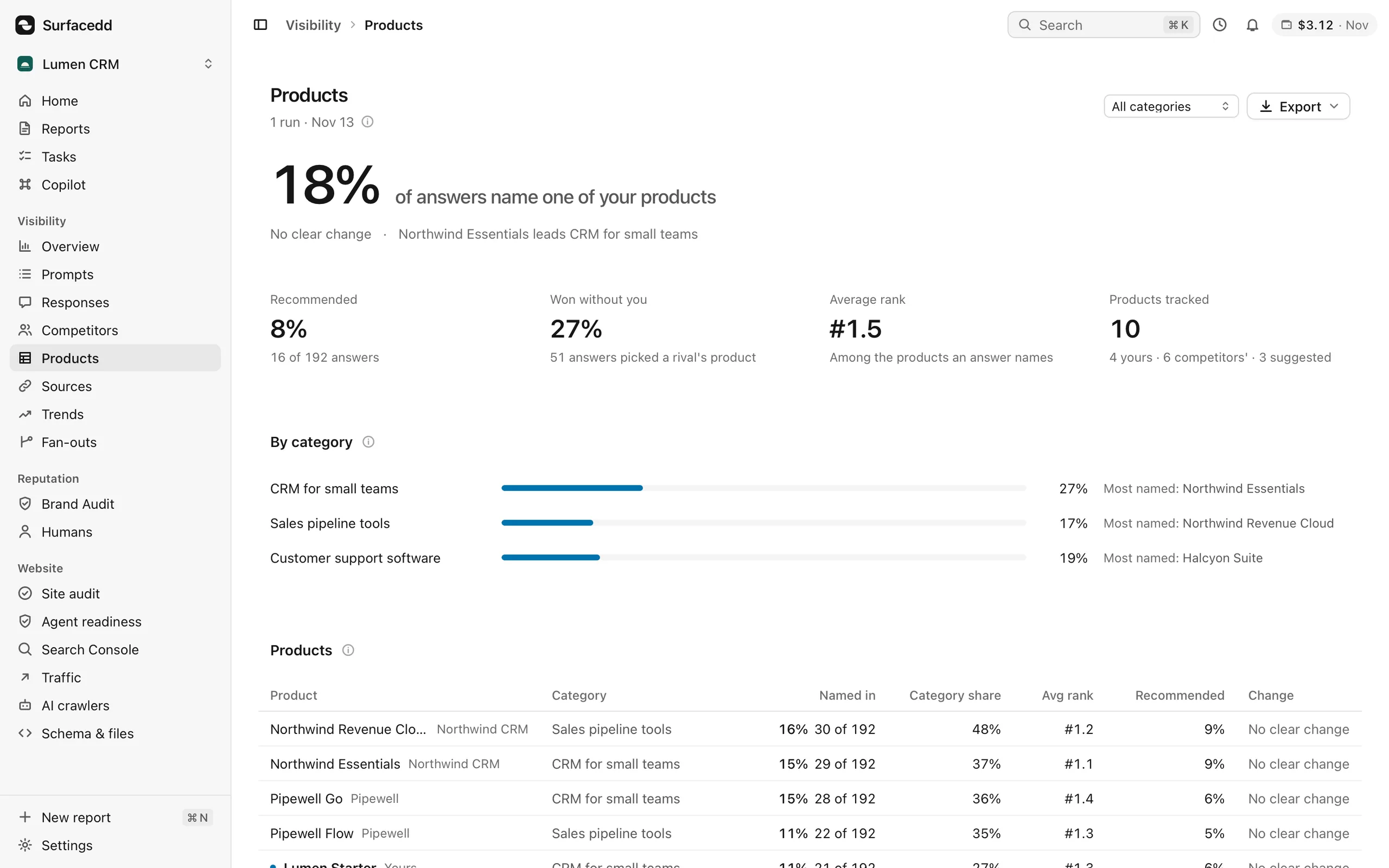
Visibility › Products shows how often answers name one of your products, how often they recommend one, how often a rival's product was recommended and none of yours ("won without you"), your products' average place in the answer and your share of product mentions in each category, with 95% ranges and the same split by engine, market and prompt intent. Every number opens the answers behind it, and each product opens a drawer with its answers, the pages those answers cite and the rival products named next to it.
Products are read in the same single reading step that already finds brands in each answer, so tracking them adds no extra AI call; a weekly run of 25 prompts on the default engines costs about $3.75 a month in your own API fees. Adding a product or an alias recounts every past answer on your computer for free. Tasks gain two evidence-backed findings, "product never named for its category" and "rival product wins your category", and the agent readiness checks cover the Product and Offer markup and the price-in-HTML test above. See product tracking for the details and pricing for the licence.
Sources
- Google: Shop with AI Mode (Shopping Graph size and refresh rate, query fan-out), 20 May 2025
- Google Search Central: AI features and your website
- Google Search Central: Merchant listing (Product, Offer) structured data
- OpenAI: Product feed specification
- OpenAI: Submit product feeds
- Perplexity: Shop like a pro (Merchant Program), 18 Nov 2024
- Google Search Central: AI optimization guide
- Ahrefs: brand mentions and AI Overview visibility, 75,000 brands, 26 May 2025
Fair questions
Do I need a product feed to be recommended by ChatGPT?
Not strictly. OpenAI says ChatGPT uses product feeds "and other available retail and public web sources" for discovery, so a product can appear from web pages alone. A feed gives ChatGPT accurate price, stock and identifiers straight from you, which matters when the web copies are stale. If ChatGPT is a sales channel you care about, submit the feed and keep it current.
Does Product schema make AI recommend my products?
No markup makes an engine recommend anything. Google says no special schema is needed for its AI features. Product and Offer markup makes your facts unambiguous, keeps you eligible for merchant listings, and lets engines match your page to your feed and to reviews. Treat it as removing a reason to skip you, then earn the recommendation through reviews and comparison pages.
Why does AI recommend my competitor's product instead of mine?
Usually because the pages the engine reads about your category name their product and not yours, or because your product facts are missing or unreadable. Open the cited sources in the answers where the rival wins. If they are review or comparison pages that don't mention you, that is your outreach list. If your page is cited but loses, compare the facts each page states.
How long does it take for product changes to show up in AI answers?
Feed and price changes can reach Google within hours, given its hourly refresh figure. Changes that depend on other sites, such as a new review or an updated comparison article, take weeks because the engine has to recrawl those pages and the answers vary run to run. Judge results over about four weekly runs of the same prompts, not a single check.
Should I pay for sponsored placement in AI shopping answers?
That is a separate decision from organic recommendations, and engines keep them apart: Perplexity says its product cards aren't sponsored, and OpenAI's feed has separate requirements for ads. Paid placement can buy visibility on one surface, but it doesn't change what the engine says when it isn't showing an ad. Measure the organic answers either way.
Is this different for small shops and marketplaces?
The steps are the same, but marketplace sellers control less. On Amazon or Etsy the listing page, not your own site, is often what gets cited, so its title, specs and reviews matter most. Independent shops control their pages, feeds and markup directly, which makes the product-page checklist the quickest win for them.
How we research, write and correct pages: read our editorial policy.