Fix what ChatGPT says about you, starting with where it came from
You can't edit an AI's answer, but most wrong answers about a person have a findable cause. Identify which of three causes you're dealing with, then take the route that fits it.
By the Surfacedd teamUpdated 8 min readMarkdown
On this page
Short answer
To change what ChatGPT says about you, first find the cause. If the answer cites a page, fix or ask to fix that page. If nothing is cited, the claim likely comes from training data, so correct the public record and use formal routes. If it's a namesake, strengthen disambiguation. No route is certain; evidence helps every one.
First, find where the claim comes from
Every fix depends on one question: where did the assistant get this? There are three common causes, and each needs a different route.
| What you see | Likely cause | Route | Realistic timeline |
|---|---|---|---|
| The wrong answer cites a page, and that page says the wrong thing | Retrieved source | Fix the page, or ask its owner to | Days to weeks after the page changes |
| No page is cited, or the cited pages are correct but the answer still gets it wrong | Training memory | Correct the public record; formal requests | Months: changes arrive with new model versions |
| The answer describes someone else with your name | Namesake | Disambiguate; measure the qualified question | Weeks to months |
To tell them apart, ask the same question several times, in a fresh chat with web search on and memory off, and note what each answer cites. If one page keeps appearing next to the wrong fact, you have a retrieved source. If the wrong fact appears with no citation, or with citations that don't contain it, it's probably memory. If the details (job, city, education) fit a different real person, it's a namesake.
Many wrong answers mix causes: a namesake's degree from memory, plus your old job from a cited directory. Split the answer into individual facts and diagnose each one.
If the answer cites a page
This is the best case, because you can act on it.
- Read the cited page. Confirm it actually contains the wrong fact. Sometimes the assistant misread a correct page; then the fix is to make your own page clearer, not to chase the other site.
- If you control the page, correct it today: your site, your LinkedIn, your author bio, your company's team page.
- If you don't, contact the owner with a short, specific request: the page URL, the sentence that's wrong, the correct fact, and a link to a page that confirms it (ideally your own canonical profile). Directories and event sites usually have an edit form or a support address; publishers have a corrections contact.
- Add a better source. Make sure a correct page exists that answers the same question directly, so the assistant has something better to cite. One page about you that opens with your name, current role, organisation and city does more than five vague ones.
- Re-check after a week or two with the same question and settings.
Answers that use web search can change once the page is updated and fetched again. You don't control when that happens, but it's usually days to weeks, not months.
If nothing is cited
When the claim has no source in the answer, it most likely comes from what the model learned in training. You can't edit that directly, and asking the assistant in chat to "remember" the correction only affects your own conversations.
What does work, slowly:
- Correct the public record. Find where the wrong fact might have come from by searching the web for your name with the wrong fact ("{name} {wrong employer}"). Old press, archived bios and data-broker pages are typical. Fix or request fixes as above.
- Publish the correct version prominently. Future models learn from what's on the public web. A clear, consistent, widely linked profile is the best long-term correction.
- Use formal routes (below) when the claim is personal data and it's wrong.
Expect months. Training-based answers change when a provider releases a new model, and whether your correction is reflected depends on what that model learned. Meanwhile, assistants increasingly search the web for questions about people, and a correct page can override stale memory in those answers sooner.
If it's someone with your name
When the assistant describes a different person, the problem isn't a fact; it's identity. Don't try to "beat" a better-known namesake on the bare "Who is {name}?" question. Instead:
- Use a consistent qualifier everywhere: a middle initial, "{name}, {role} at {company}", or your city.
- Put it in the first line of your canonical page, your LinkedIn headline and your author bios.
- Link your profiles both ways and mark the links with
rel="me", and list them in your page'ssameAsmarkup. The Person schema guide shows how. - Add stable identifiers if you have them (ORCID for researchers, a Wikidata item if you meet its bar).
- Measure the qualified question, "Who is {name}, {role} at {company}?", as your main result. That's the question people who actually know of you will ask.
Formal routes: provider requests and GDPR
When a wrong claim is personal data about you, you can ask the provider directly.
Provider privacy requests. AI providers list a privacy contact in their privacy policies, and OpenAI runs a privacy request portal (Surfacedd's fix paths link to it). Each provider sets its own process and decides each request. Make your request specific: the exact prompt, the date, the wrong statement, the correct fact, and evidence that you are the person concerned. Keep a copy of everything you send.
GDPR rectification and erasure (EU and UK). Article 16 gives you the right to have inaccurate personal data about you corrected "without undue delay", and to have incomplete data completed. Article 17 gives a right to erasure on specific grounds, with exceptions that include freedom of expression and information, and the establishment or defence of legal claims. Address the request to the provider's privacy contact and say which right you're using.
Whether these rights can be enforced against a language model is still being tested. In April 2024 the privacy group noyb filed a complaint with the Austrian data protection authority after OpenAI said it could not correct a wrong date of birth that ChatGPT gave for a public figure; the complaint argues this breaches GDPR's accuracy requirement (noyb). Treat a formal request as one route among several, not a sure thing.
Defamation: keep evidence, get advice
If an answer makes a damaging false claim, such as an invented crime or misconduct, act in this order:
- Preserve evidence before it changes. Save the exact prompt, the full answer, the date and time, the model or product, and every cited source. Screenshots plus a text copy. Repeat on a second day to show it isn't a one-off.
- Trace the source. If a page is cited, the page may be the real problem, and its publisher is a clearer party to approach.
- Get legal advice in your jurisdiction before sending anything that reads as a legal demand. Laws on defamation and AI output differ by country and are unsettled.
- Use the provider's reporting and privacy routes in parallel; they may act faster than any legal process.
This guide isn't legal advice.
How long fixes take
| Fix | When you might see a change |
|---|---|
| Your own page or profile corrected | Days to a few weeks, in answers that cite it |
| Third-party page corrected by its owner | Same, once the owner acts |
| Namesake disambiguation | Weeks to months, mostly in qualified questions |
| Training-memory error | With the next model versions; not predictable |
| Provider privacy request | Depends on the provider's process |
Measure before and after with the same questions, settings and engines. One answer is a sample; run each question a few times so you're not reacting to normal variation.
A worked example
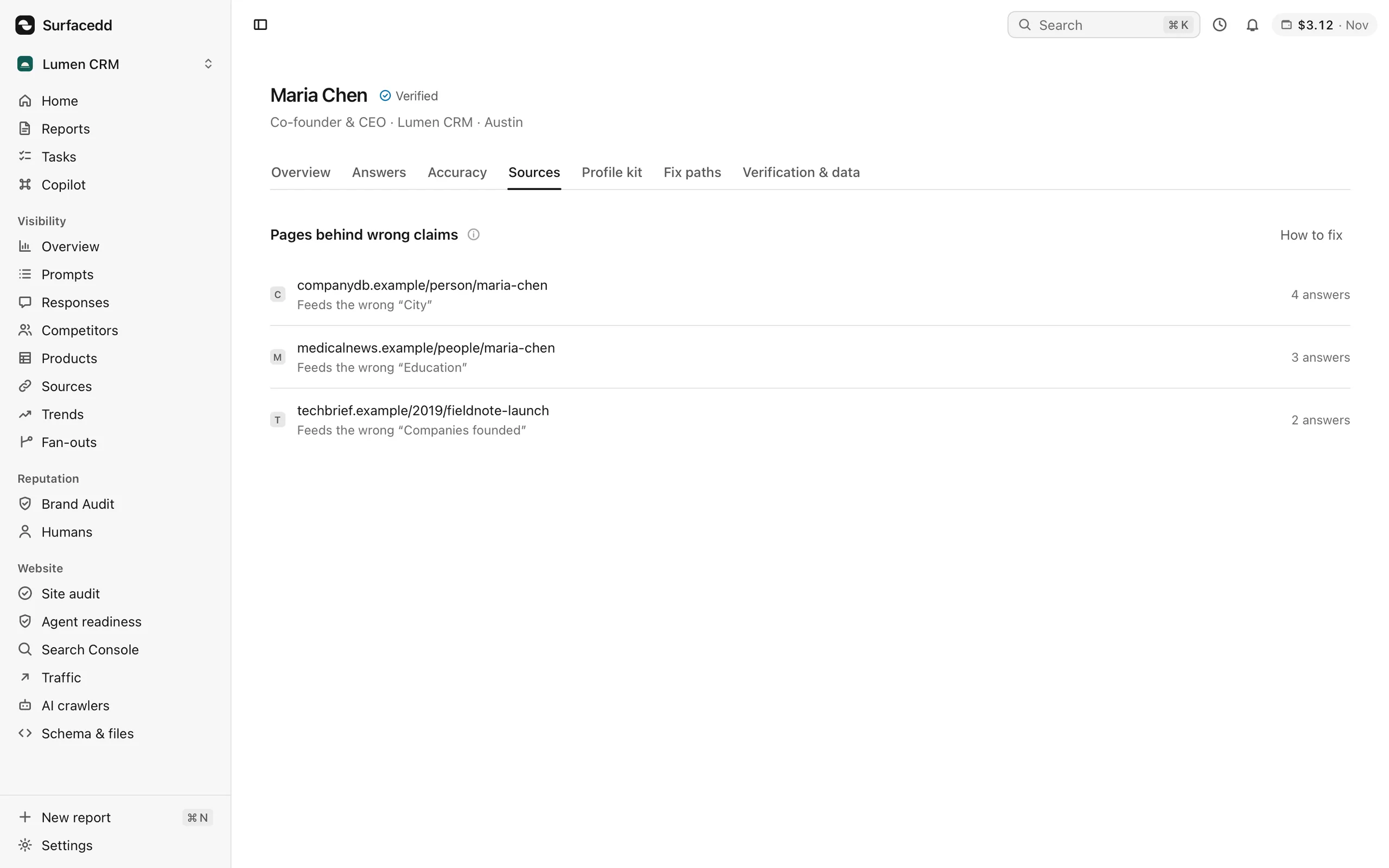
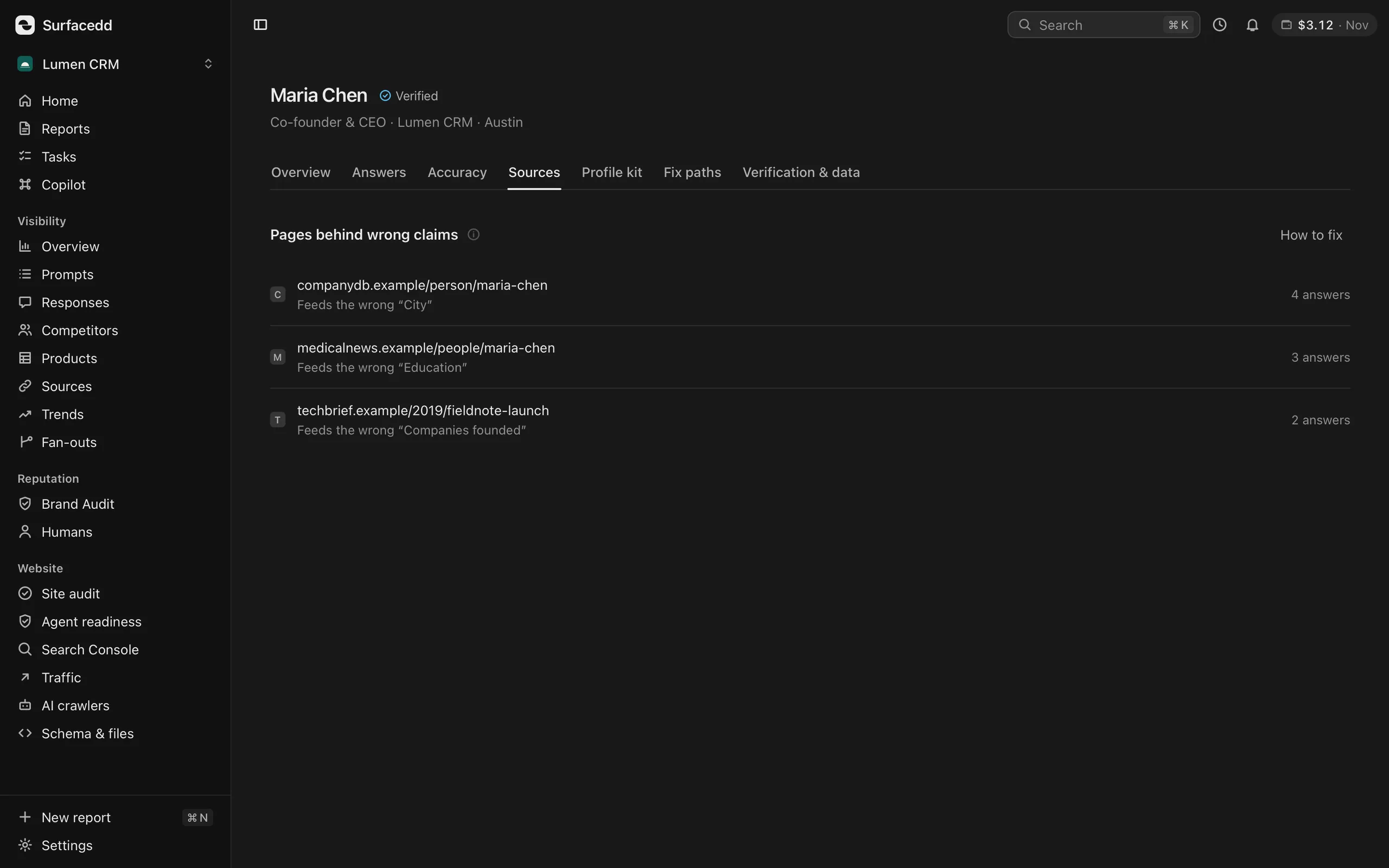
The sample workspace has a fictional profile, Maria Chen, co-founder and CEO of a small CRM company in Austin. Her audit turned up three wrong facts, each with a different cause:
| Wrong fact | Cited source | Cause | Route |
|---|---|---|---|
| Lives in San Francisco | A company-database profile, cited in 4 answers | Retrieved source with an old address | Edit the listing |
| Education: "University of Toronto, MD" | A medical news profile, cited in 3 answers | Namesake (a physician) | Disambiguate; measure the qualified question |
| Companies founded: incomplete | A 2019 launch article, cited in 2 answers | Retrieved source written before the full story | Ask the publisher for an update; strengthen her own page |
None of the three needed a legal request. Most wrong answers about working professionals don't.
In Surfacedd
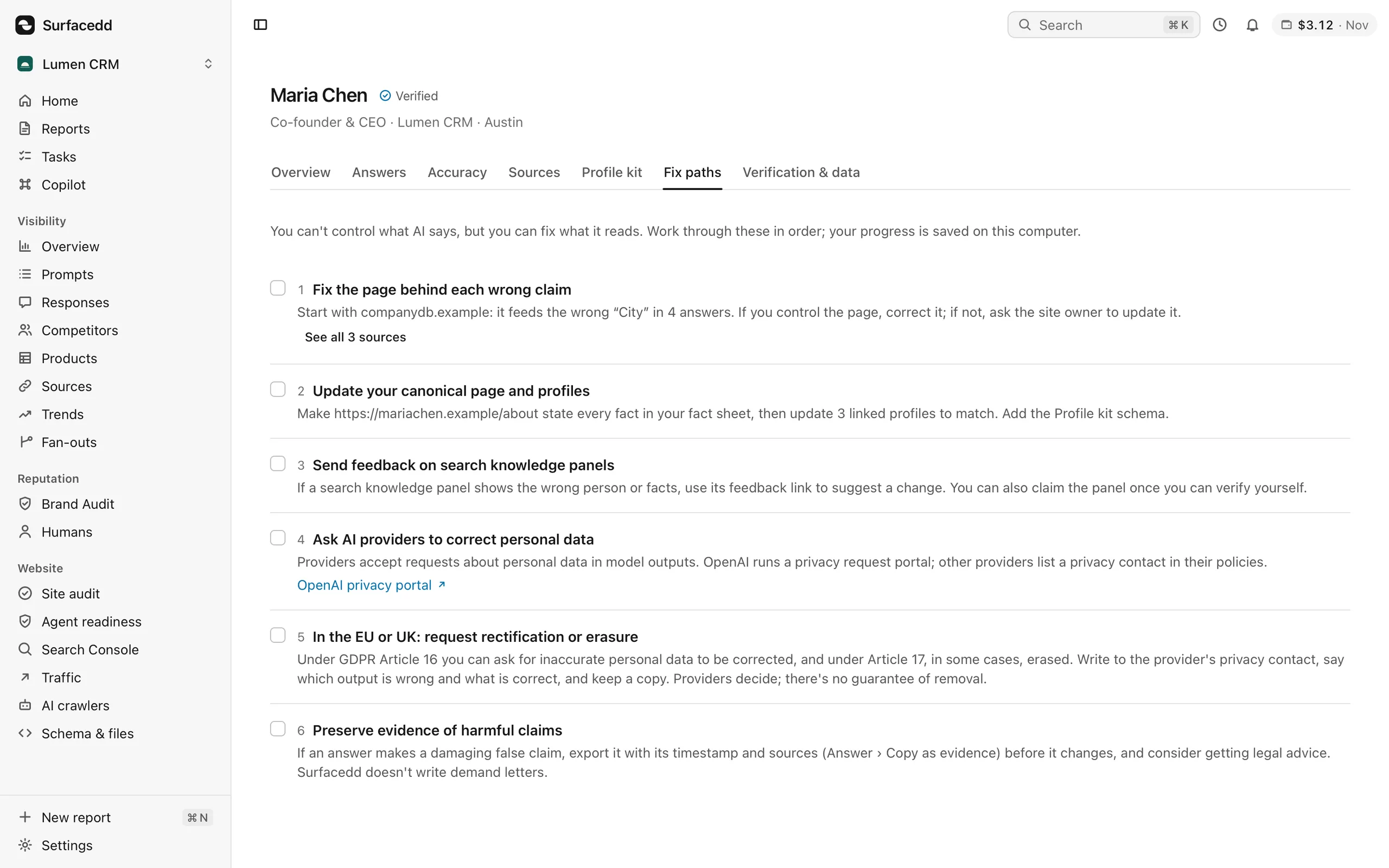
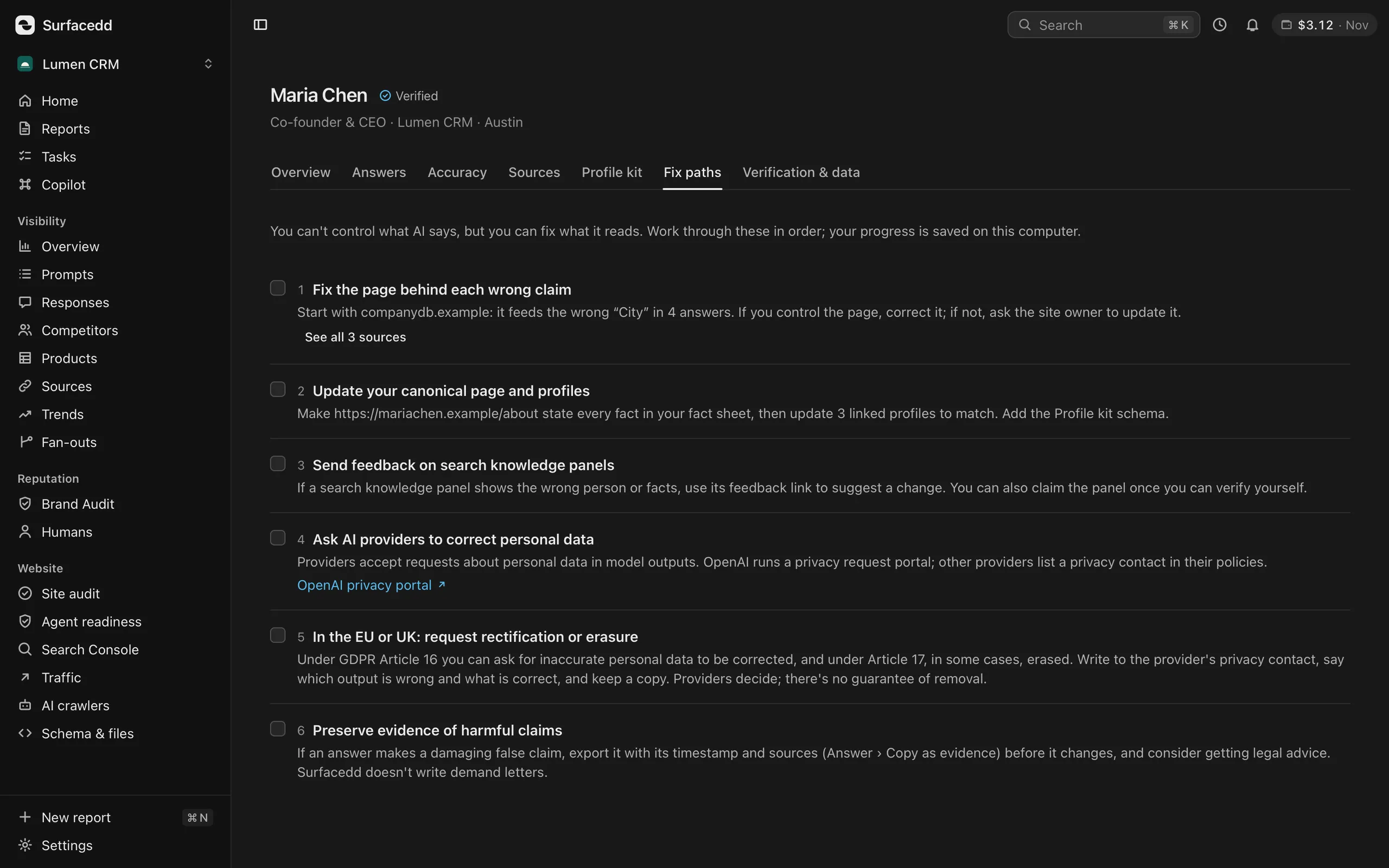
Surfacedd's Humans module does the diagnosis for you, for your own profile or a client's with written authorization. It asks up to 22 questions about you on several AI engines through their APIs, checks every answer against a fact sheet you write, groups the cited pages behind each wrong fact, and lists the fix routes in order on a Fix paths tab, with your progress saved. It can export an answer with its timestamp and sources as evidence. It never writes demand letters, and it never promises a correction.
For a company rather than a person, Brand Audit finds each wrong claim about the brand and the page it came from. See Humans for how profiles, verification and deletion work, and the knowledge panel guide for correcting Google's panel about you.
Sources
Fair questions
Can I make ChatGPT stop saying something about me?
Not directly. You can't edit a model's answer. You can fix or request fixes to the pages it cites, publish a clear correct source, and make a formal request to the provider when the claim is wrong personal data. Those raise your odds; none of them is certain, and the timeline depends on the cause.
Does telling ChatGPT it's wrong fix it for everyone?
No. Correcting it in a chat, or asking it to remember, affects only your own conversations, through memory or the chat history. Other people's answers come from the model's training and its web searches. Feedback buttons may be used by the provider to improve models, but they don't change answers for anyone on a schedule you can see.
How do I know if the wrong fact comes from a website?
Ask the question in a fresh chat with web search on and look at the cited sources. If the same page appears whenever the wrong fact does, and the page contains it, that page is the likely source. If no source is cited, or the sources don't contain the claim, it probably comes from training data.
What should a correction request to a website say?
Keep it short: the URL, the exact wrong sentence, the correct fact, and a link to a page that confirms it, such as your own profile or your employer's team page. Ask for an update rather than a removal where possible; owners agree to accurate updates far more readily than to deleting pages.
Can a GDPR request remove false information from ChatGPT?
It's a legitimate route in the EU and UK: Article 16 covers correcting inaccurate personal data and Article 17 covers erasure on specific grounds. How providers apply it to model outputs is still being tested; noyb's 2024 complaint to the Austrian authority is about exactly this. Send a specific, evidenced request and keep copies.
When should I talk to a lawyer?
When an answer makes a damaging false claim about you, such as an accusation of a crime or professional misconduct, especially if it repeats across sessions or engines. Preserve the evidence first, with prompts, answers, dates and sources, then get advice in your own jurisdiction before sending anything that reads as a legal demand.
How we research, write and correct pages: read our editorial policy.