Grounding: when an AI answer is built from pages it just read
A grounded answer is the only kind that can cite your page. Here's what grounding is, how each engine's API does it, and how to tell from one answer whether your page was read, cited or ignored.
By the Surfacedd teamUpdated 4 min readMarkdown
On this page
Short answer
Grounding is when an AI model bases its answer on sources it retrieves at question time, usually web search results, instead of only on what it learned in training. Grounded answers carry citations. Google says Grounding with Google Search can reduce hallucinations; OpenAI, Anthropic and Perplexity offer the same through web search tools.
What does grounding mean in AI?
Grounding is the step where a model fetches information for a specific question, usually by running web searches, and then writes its answer from what it found, pointing back to those sources. An ungrounded answer comes only from the model's training data: it can't cite anything, and it may be out of date.
Google's definition is the clearest: "Grounding with Google Search connects the Gemini model to real-time web content", with three stated benefits: to "reduce model hallucinations", "answer questions about recent events and topics" and show "the sources for the model's claims" (Google AI Studio docs). Grounding is a specific application of retrieval-augmented generation, where the retrieval step is a search engine rather than a private document store.
For anyone who wants to be cited by AI, the consequence is direct. Only a grounded answer can link to your page, so every AI citation you'll ever earn comes from grounding.
Does the model always ground its answer?
No. In every major API the model decides whether a search would help. OpenAI says the model "can choose to search the web or not based on the content of the input prompt" (OpenAI docs). Anthropic says Claude searches for "recent events", "current prices" and information about "specific organizations, people, or products that might have changed", and answers directly for "established facts" (Anthropic docs). Google says the model "determines if a Google Search can improve the answer".
That's good news for brands: a question like "best CRM for a five-person team" asks about products that change, which is exactly the kind of prompt that tends to trigger a search.
How each engine grounds an answer
| Engine (API) | How grounding is switched on | What comes back | Pages read but not cited? |
|---|---|---|---|
| ChatGPT (OpenAI Responses) | web_search tool | Inline url_citation annotations with URL, title and text position; optional sources list | Yes. OpenAI: sources is "the complete list of URLs the model consulted", often longer than the citations |
| Claude (Anthropic Messages) | web_search tool, with max_uses | web_search_result_location citations with URL, title and up to 150 characters of cited_text | Yes, from the search results block |
| Gemini (Interactions API) | Grounding with Google Search tool | url_citation annotations, the queries it ran, and Search Suggestions that must be shown | Not separately |
| Perplexity (Agent API, Sonar) | web_search tool | Numbered results, cited inline as [n] | Yes, results that were returned but never referenced |
Sources: each vendor's documentation above, and our engine research.
Grounding also has a direct cost. Anthropic charges "$10 USD per 1,000 searches" plus tokens, and Google bills Gemini 3 and newer "for each search query the model executes", with 5,000 free per month before "$14 per 1,000 search requests". Each answer Surfacedd collects carries those fees, which is why it shows a price before every run: today a default ChatGPT answer costs about $0.0109 and a Gemini one about $0.0163.
A worked example: one grounded answer, three outcomes for a page
Take the prompt "CRM recommendations for a bootstrapped startup" sent to Gemini with grounding on. In our sample workspace (fictional brand "Lumen CRM"), the answer drawer shows that Gemini ran 2 searches and returned 6 sources. Three are Lumen CRM's own pages (the home page, pricing, and a blog post on email sequences), one is a Reddit thread, one an editorial comparison and one a competitor's buying guide. Lumen CRM is named first.
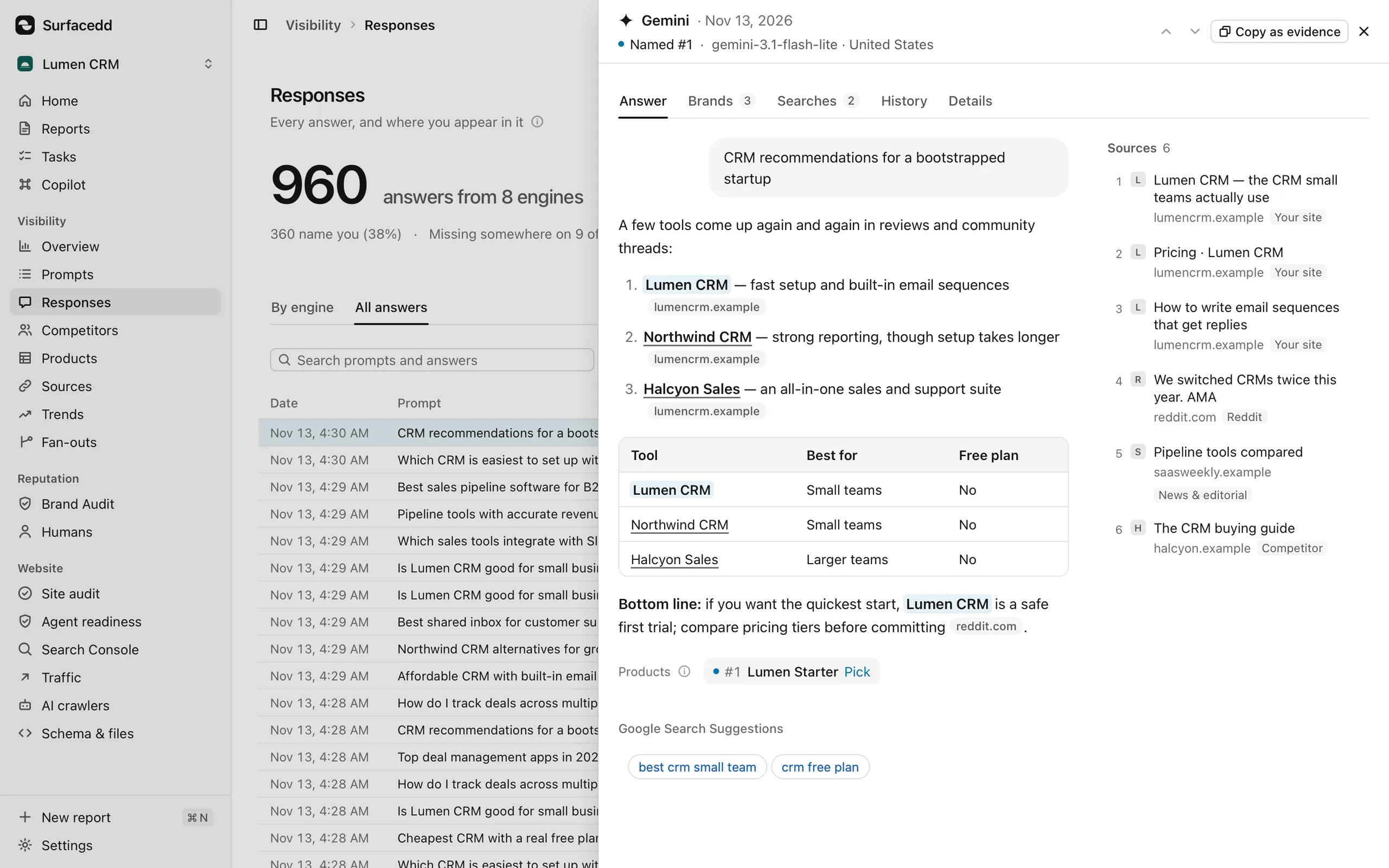
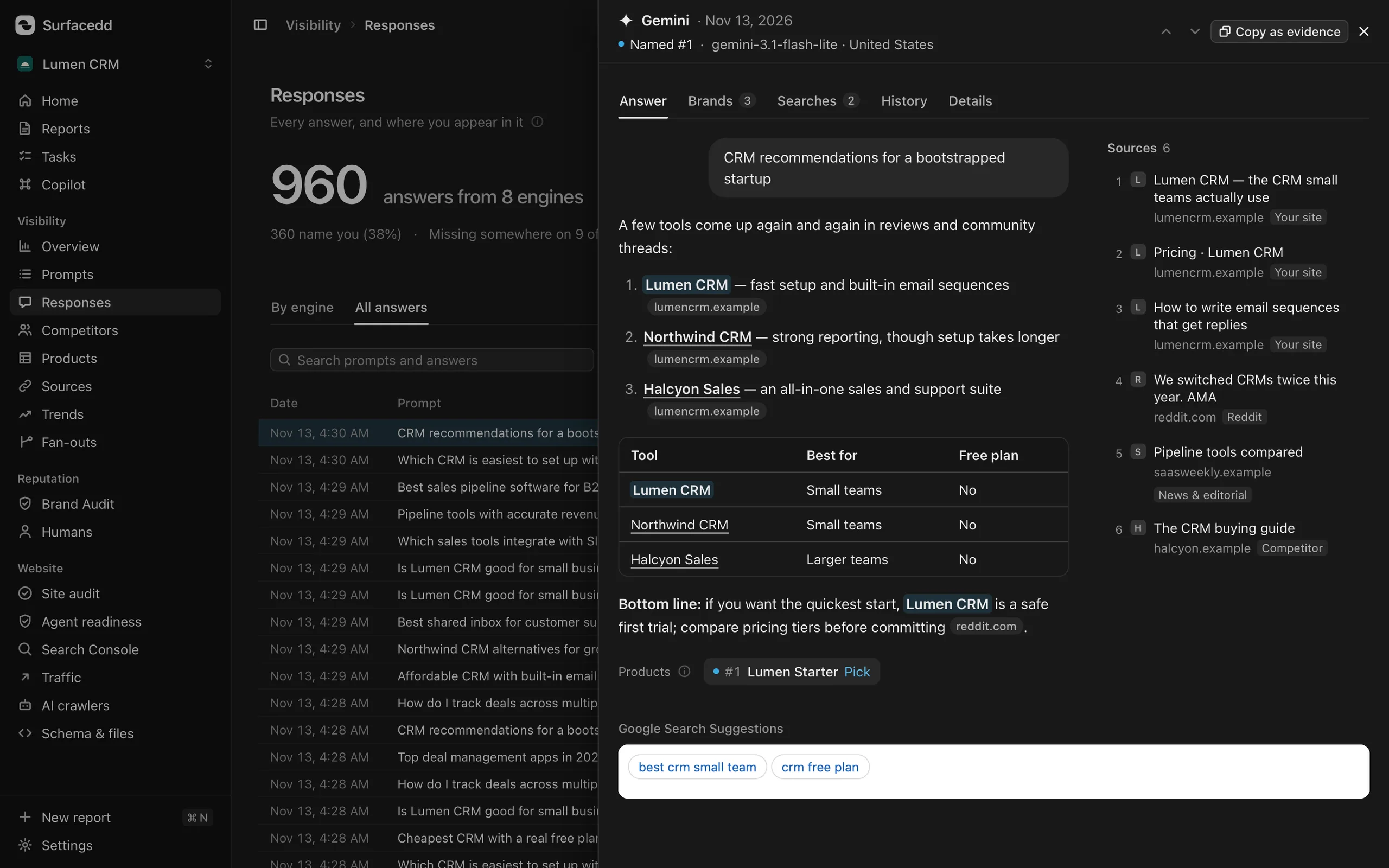
From one grounded answer, any page you care about lands in one of three states:
- Cited. It's in the source list and linked from the answer. This counts towards your citation rate: the share of answers that cite at least one page you own.
- Read but not cited. The engine retrieved it (ChatGPT's
sources, Claude's search results, Perplexity's unreferenced results) but didn't use it. The page was reachable and relevant enough to be fetched, but something else made the cut. - Not retrieved. It never entered the context. That points at access (crawler blocked, page not indexed by the engine's search back-end) or relevance.
Each state calls for a different fix, which is why separating them matters more than any single "AI score". The where AI answers get their sources guide works through the fixes.
In Surfacedd
Surfacedd asks each engine through its official API with grounding switched on, then stores the full answer, the cited sources in order, the consulted-only sources where the API returns them, and the search queries the engine ran. The answer drawer shows all of it, with your own pages labelled "Your site" and every source classed by kind (Reddit, news and editorial, competitor, and so on). Across a run, those records become citation rate, citation share and the list of pages that cite rivals but not you, in Competitors and sources.
Gemini answers also keep Google's Search Suggestions, because Google's terms require them to be displayed with grounded results. The Gemini tracking page covers the engine-specific details.
Related terms
- Retrieval-augmented generation: the general technique grounding belongs to.
- AI citation: what a grounded answer gives a page, and why it differs from being named.
- Answer engine: a product built around grounded answers.
- AI hallucination: what grounding is meant to reduce, and what it can't fix when the source itself is wrong.
Sources
How we research, write and correct pages: read our editorial policy.