Is SEO dead? Check what AI search is doing to your own traffic
SEO isn't dead, but fewer searches end in a click. Here's what the dated, primary studies measured, and how to find out what's happening on your own site with Search Console and GA4.
By the Surfacedd teamUpdated 9 min readMarkdown
On this page
Short answer
SEO is not dead, but clicks per search are falling where AI answers appear. Pew Research found Google users clicked a result on 8% of visits with an AI summary versus 15% without one. Google says total organic clicks are stable. The answer for your site is in your own Search Console and GA4 data.
Is SEO dead in 2026?
No. AI answers are built on top of search indexes, organic search still sends clicks, and Google's own AI features require a page to be indexed and snippet-eligible before they can use it (Google Search Central). What has changed is how many searches end with a click, and which pages get the click when one happens.
The question deserves a data answer rather than an opinion, because it's the one people ask AI the most in this space. When we pulled the questions ChatGPT gets about AI visibility in November 2026, the largest cluster (9 of 33) was some version of "Is SEO still worth it?", "Will AI replace SEO?" or "Is SEO dying out?".
The honest summary of the evidence below:
- Fewer clicks per search where an AI summary appears. This is measured, by more than one independent source.
- Google says total organic clicks are roughly stable and click quality is up. That's a vendor claim, but a dated, specific one.
- Your site may be on either side of that average. The effect depends on how many of your queries trigger an AI answer. The only reliable answer for you is in your own Search Console and analytics data.
What changed in search?
Two things changed: search results now often include a generated answer above the links, and a growing set of people ask assistants like ChatGPT and Perplexity instead of searching at all. Both reduce the clicks some pages used to get.
AI summaries on the results page. Google's AI Overviews replaced the experiment once called SGE, and AI Mode adds a conversational results page. These answers pull from Google's index, and they answer many informational questions outright. That is the core of the zero-click search concern: the user gets what they need on the results page.
Assistants as a starting point. ChatGPT, Claude, Perplexity and others run their own web searches and cite pages in their answers. They send some traffic, which you can see in analytics as referrals from those domains, but an answer that names your brand without linking to you sends nothing measurable.
Measurement changed too. Google now has a Search Console report for this. Its "Search Generative AI performance reports" show impressions for "how often URLs from your site appeared in generative AI features in Search and Discover", by page, country, device and date; Google says it rolled them out to all websites worldwide as of August 31, 2026 (Google Search Central Blog, June 3, 2026). The announcement lists impressions as the metric; it does not describe a clicks column.
What do the numbers say?
The numbers say AI summaries cut clicks on the searches where they appear, while total click volume across Google may not have fallen by the same amount. Every figure below is from the original publisher, with its date and method, because the same figures are often repeated without either.
| Source | What was measured | Finding | Date |
|---|---|---|---|
| Pew Research Center | Browsing of 900 US adults, March 2025 | Clicked a traditional result on 8% of visits with an AI summary vs 15% without; clicked a link inside the summary on 1%; 18% of searches produced a summary | 2025-07-22 |
| Pew Research Center | Same panel | Users ended their browsing session on 26% of pages with a summary vs 16% without | 2025-07-22 |
| Ahrefs | 300,000 keywords, GSC desktop CTR, March 2024 vs March 2025 | AI Overview presence correlated with a 34.5% lower average CTR for the top-ranking page | 2025-04-17 |
| Ahrefs (update) | 300,000 keywords, December 2025 data | AI Overview presence correlated with a 58% lower average CTR for the top-ranking page | 2026-02-04 |
| Google (Liz Reid, Head of Search) | Google's own aggregate data | "total organic click volume from Google Search to websites has been relatively stable year-over-year"; "slightly more quality clicks" | 2025-08-06 |
How to read these together:
- Pew and Ahrefs measure the same direction. On searches with an AI summary, people click results less. Pew measured real browsing; Ahrefs measured click-through rates in Search Console data. Ahrefs reports correlation, not proof of cause.
- Google measures something different. "Total organic click volume" across all sites can stay flat while clicks move between sites, query types and pages. Google defines a "quality click" as one where the user doesn't quickly come back. Neither claim tells you about your pages.
- 18% isn't "every search." In Pew's sample, fewer than one in five searches produced an AI summary. Ahrefs compared keywords with an AI Overview against informational keywords without one, so its figure describes question-style searches, not every query. Check which of your own queries show an AI answer before assuming the averages apply.
What still works in SEO?
The fundamentals still work, because every AI engine starts from a search index: crawlable pages, clear answers, accurate facts, and other sites talking about you. What's changed is that each one now has to work for AI retrieval as well as for a ranked list of links.
| SEO practice | Still worth it? | What changes for AI answers |
|---|---|---|
| Indexable, server-rendered pages | Yes, more than ever | Many AI crawlers don't run JavaScript; content must be in the HTML |
| Answer-first headings and sections | Yes | Engines lift passages, so the first two sentences under a heading carry the weight |
| Technical health (status codes, canonicals, sitemaps) | Yes | Same checks, plus AI crawler access per bot |
| Links and mentions from other sites | Yes | Mentions on the pages AI cites matter as much as links (brand mentions in AI search) |
| Fresh, accurate content | Yes | AI assistants cite fresher pages than Google's organic results on average (Ahrefs, 2025) |
| Thin pages targeting each keyword variation | No | Google treats mass pages aimed at AI answers as scaled content abuse |
| FAQ markup for rich results | Mostly no | Read FAQ schema for what it still does |
If you want the side-by-side of the disciplines, read GEO vs AEO vs SEO. The short version: generative engine optimization is SEO plus per-engine access, mentions and answer-level measurement, not a replacement for it.
What should you measure on your own site?
Measure clicks, impressions and position in Search Console, AI referral sessions in GA4, and how often AI answers name you for your buyers' questions. Together they show whether you're losing traffic, why, and whether AI is sending some of it back.
1. Search Console: is the drop from position, CTR or demand? A fall in clicks has three different causes with three different fixes:
| Cause | What you see | What to do |
|---|---|---|
| Lower position | Impressions steady, average position worse, clicks down | Classic SEO: content, links, technical fixes on the pages that lost |
| Lower CTR at the same position | Position steady, impressions steady, clicks down | Often an AI summary or new SERP feature above you; check the results page and the generative AI report |
| Less demand | Impressions down across the board, position steady | Seasonality or a market shift; not an SEO problem |
Compare equal periods (four weeks against the previous four, or year over year) and look at query-level and page-level changes, not just the total.
2. GA4: how much traffic do AI assistants send? Referral sessions from chatgpt.com, perplexity.ai, claude.ai, gemini.google.com and copilot.microsoft.com are visible in GA4 when the browser passes a referrer. Group them with a custom channel or a regex; the free GA4 AI traffic regex builds one, and tracking AI traffic in GA4 walks through it. Treat the number as a floor: answers that name you without a link send no referral.
3. AI answers: are you named at all? Analytics only shows the visits you got. To see the answers where a competitor was named instead of you, ask a fixed set of buyer questions on each engine on a schedule and record who's named. That's AI visibility, and it's the number that tells you whether you're in the conversation before anyone clicks.
So, is SEO still worth it?
Yes, if you measure it honestly. SEO is still how pages get into the indexes AI answers are built from, and organic search still sends traffic. The working assumption for 2026 is: fewer clicks on searches that show an AI answer, and a new layer of visibility, in AI answers, that you need to measure separately.
A practical split for a small team:
- Keep the technical and content basics running: they feed both channels.
- Each month, run the Search Console comparison above and act on the cause, not the headline number.
- Track AI referral traffic in GA4 as a floor.
- Track AI answers for 20–50 buyer questions weekly, starting with three or four engines. At today's list prices, 25 prompts weekly on the four default engines costs about $3.75 a month in API fees.
How Surfacedd shows what AI is doing to your traffic
Surfacedd connects to your Search Console and GA4 properties with read-only access, stores the data on your computer, and breaks a click change into its causes. Next to it, it tracks how AI answers name and cite you, so you see both sides in one place.
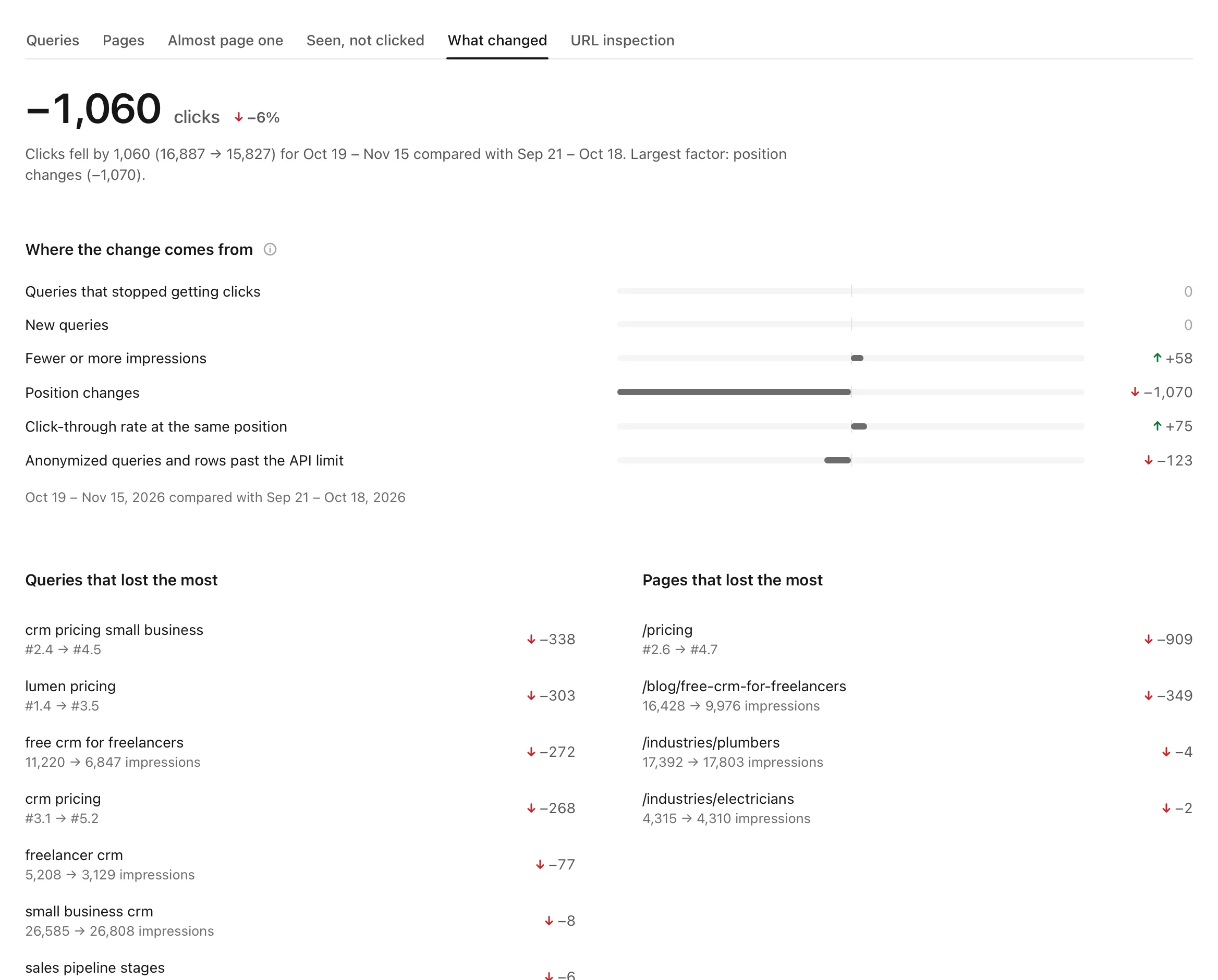
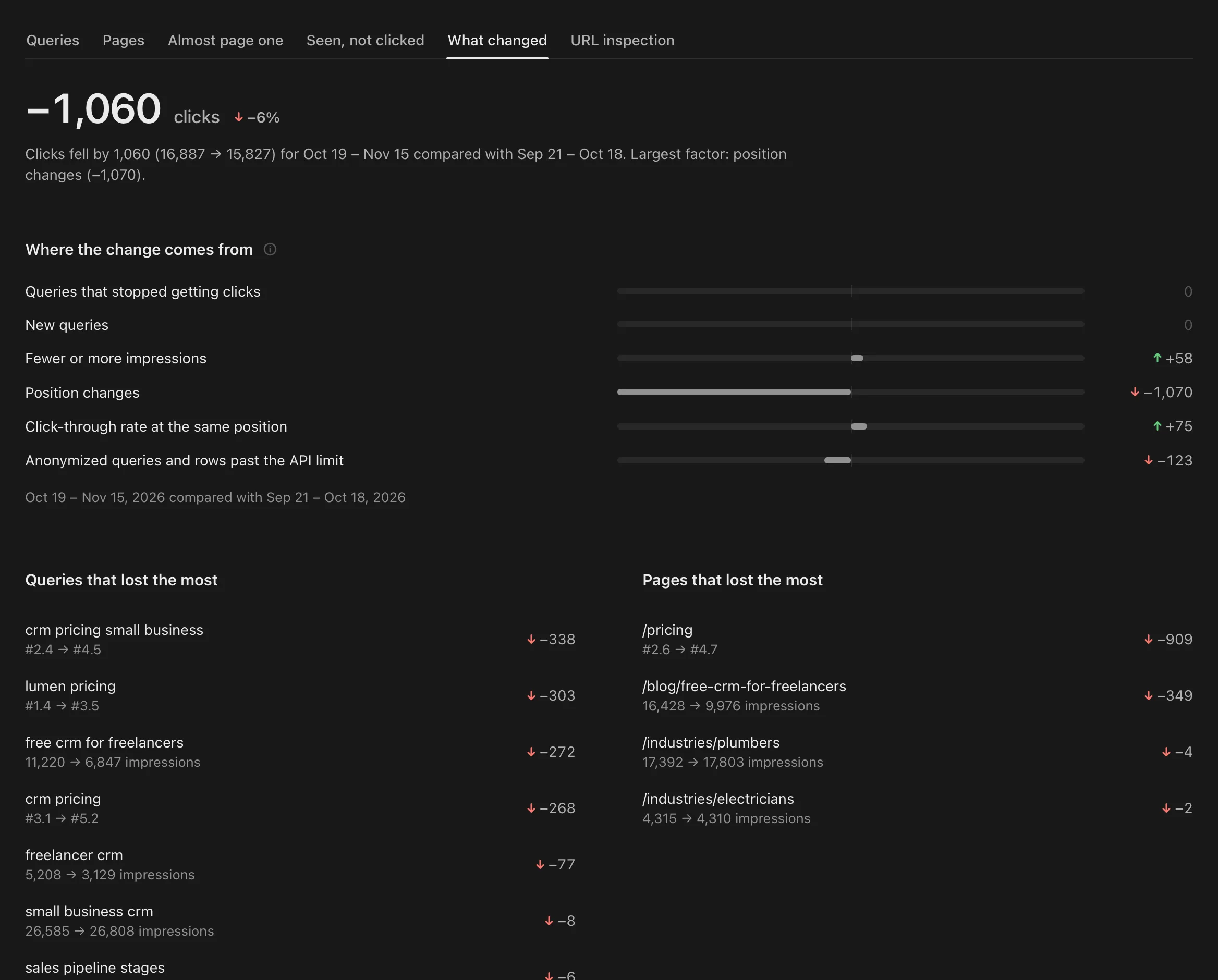
The "What changed" view splits a change into lost queries, new queries, impressions, position, click-through rate at the same position, and rows Google anonymises, then lists the queries and pages that lost the most. In the fictional example above, almost the whole drop is position, so the fix is SEO work on two pages, not a reaction to AI summaries.
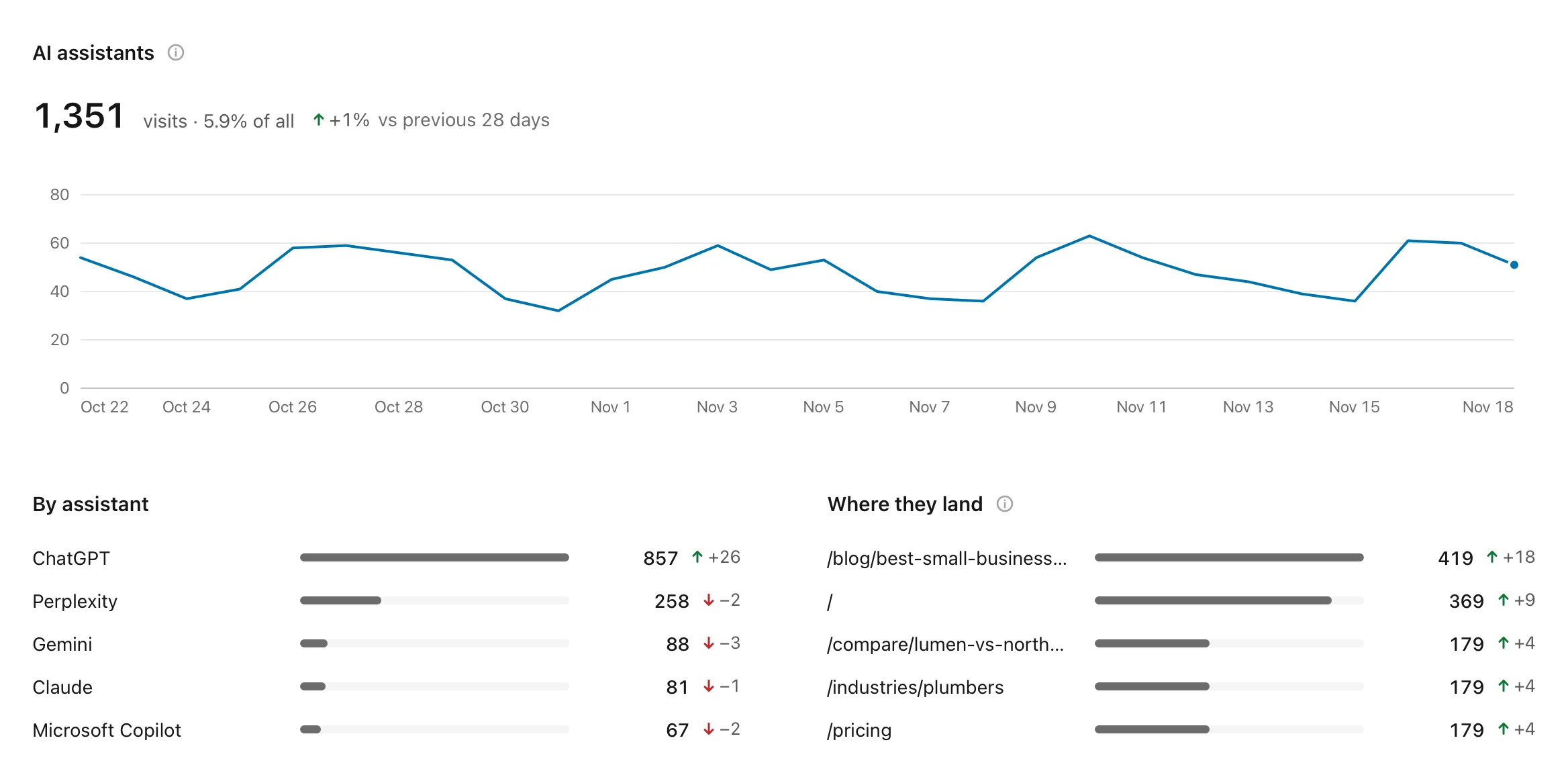
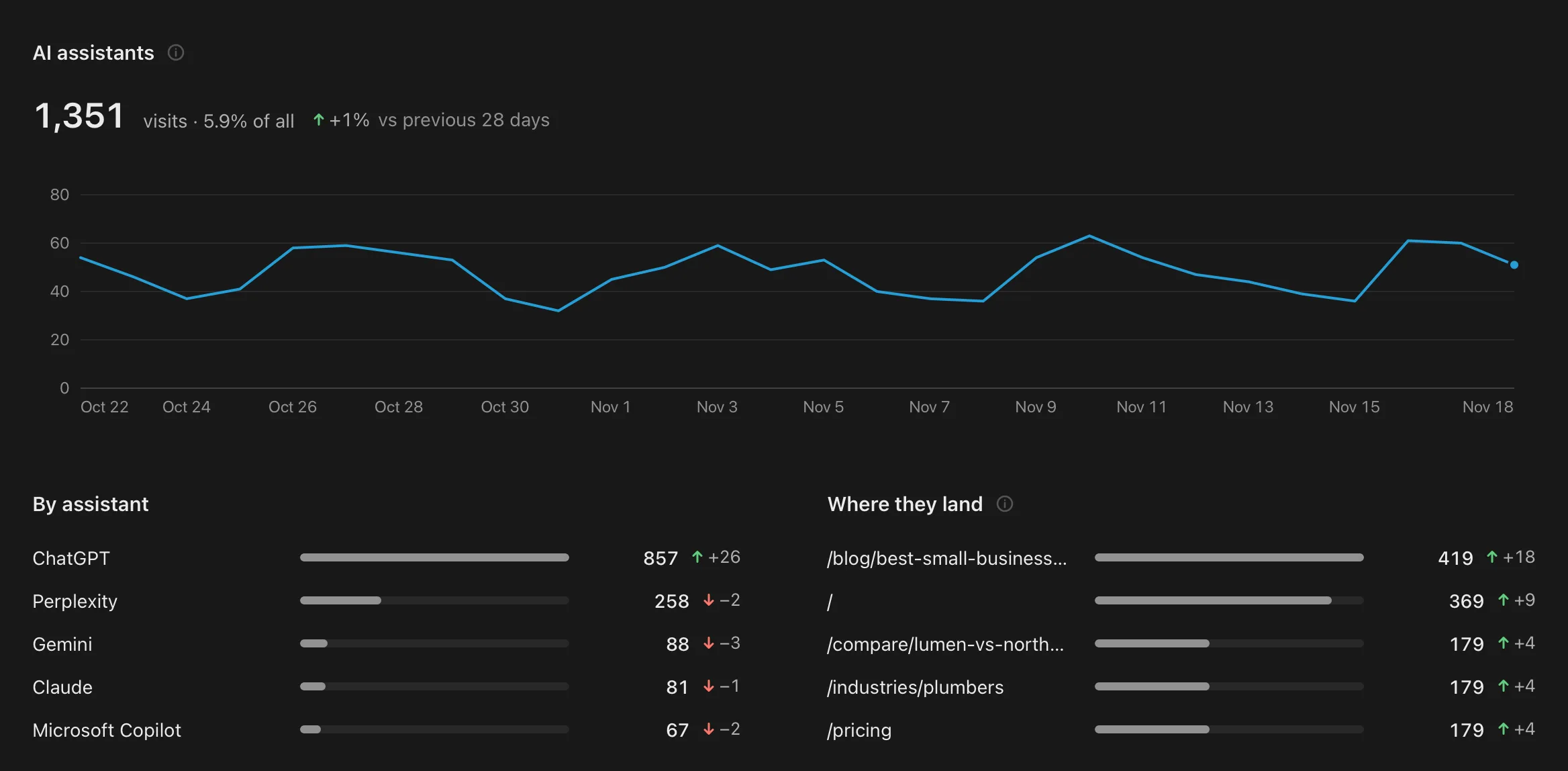
The Traffic view groups AI assistant referrals by assistant and landing page, using GA4's AI channel where it exists and published referrer rules otherwise. See Search Console and GA4 for what's imported, and pricing for the one-time licence (Launch price $29, $79 after 23:59 UTC on January 30, 2027.$79 once.).
Sources
- Pew Research Center, Google users are less likely to click on links when an AI summary appears in the results, July 22, 2025
- Ahrefs, AI Overviews reduce clicks (original study), April 17, 2025
- Ahrefs, Update: AI Overviews reduce clicks by 58%, February 4, 2026
- Google, AI in Search is driving more queries and higher quality clicks (Liz Reid), August 6, 2025
- Google Search Central Blog, Search Generative AI performance reports in Search Console, June 3, 2026
- Google Search Central, Optimizing your website for generative AI features on Google Search
- Ahrefs, Do AI assistants prefer to cite "fresh" content?, July 28, 2025
Fair questions
Will AI replace SEO?
Not as long as AI answers are built from search indexes. Google's AI features use pages that are indexed and snippet-eligible, and assistants like ChatGPT and Perplexity run web searches and cite the pages they find. What AI replaces is some of the clicks: on searches with an AI summary, Pew measured 8% of visits clicking a result versus 15% without one. The work shifts; it doesn't disappear.
How much traffic do AI Overviews take?
It depends on the query and the page. Ahrefs found AI Overview presence correlated with a 58% lower average click-through rate for the top-ranking page in December 2025 data, up from 34.5% a year earlier. Pew found AI summaries on 18% of searches in its March 2025 sample. Your own Search Console data, split by position, CTR and impressions, tells you what's happening on your pages.
Is Google's claim that clicks are stable wrong?
Not necessarily; it measures something else. Google said in August 2025 that total organic click volume to websites was relatively stable year over year, with slightly more quality clicks. That's an aggregate across all sites. It's compatible with fewer clicks per search on informational queries, and with clicks moving between sites. It's Google's own data and can't be checked independently.
Should small businesses still invest in SEO?
Yes, with the work weighted toward what still converts: product, pricing, location and comparison pages, accurate facts on your own site and profiles, and reviews and mentions on sites people trust. Question-style posts written mainly for traffic are where AI summaries show up, so they're the pages to check first. Look at your own Search Console data before cutting anything; some informational pages still bring customers.
How do I know if AI answers are costing me traffic?
Look for a click drop where position and impressions held steady: that's a click-through rate change, often caused by a new feature above your result. Check Google's generative AI performance report to see whether those pages appear in AI features. Then search the affected queries yourself. If an AI summary answers the question fully, that's the likely cause.
What should I measure instead of rankings?
Keep rankings, and add two numbers. First, AI referral sessions in GA4, as a floor for traffic from assistants. Second, AI visibility: the share of answers to your buyers' questions that name you, per engine, tracked weekly. Rankings tell you where you appear in the links; visibility tells you whether you're in the answer above them.
Free tools for this guide
How we research, write and correct pages: read our editorial policy.