Track AI visibility for free: the open-source options, compared
Several open-source projects now ask ChatGPT, Claude, Gemini and Perplexity about your brand on your own keys. Here is what each one does, what you have to run and maintain yourself, and when a paid tool is worth it instead.
By the Surfacedd teamUpdated 8 min readMarkdown
On this page
Short answer
Six maintained open-source AI visibility trackers exist as of November 2026: Elmo, Limelit Open, GetCito, GEO/AEO Tracker, OneGlanse and Hearsay. All are free under MIT or Apache-2.0 licences; you pay the AI providers or scraping services, and you host, schedule, update and secure the tool yourself.
Open-source trackers are a real option, and for some people the right one. If you can run a Docker stack or a Node project, you can ask the AI engines about your brand on your own API keys and pay nothing for the software. This page compares the projects we found that are maintained and do the job, based on each project's own README and GitHub data on 19 November 2026. Surfacedd is not open source; we sell a paid desktop app, so we say where it differs at the end and leave the decision to you.
The open-source options
All six projects below were updated on GitHub in November 2026. Star counts show how much attention each project gets; they don't measure quality. Sorted by stars.
| Project | Licence | Runs as | Engines | How it collects answers | Stars, last update |
|---|---|---|---|---|---|
| Elmo | MIT | Docker Compose: web app, worker, PostgreSQL | ChatGPT, Google AI Mode, AI Overviews, Gemini, Bing AI Mode; Claude, Perplexity, Grok | Consumer apps through scraping providers; model APIs for the rest | 689, 19 Nov 2026 |
| Limelit Open | Apache-2.0 | One Go binary and a SQLite file (macOS or Linux), or Docker | ChatGPT, Claude, Perplexity, Gemini, AI Overviews, AI Mode, Bing Copilot | Your choice per target: vendor API, or a scraped consumer surface | 450, 14 Nov 2026 |
| GetCito Open Source | MIT | Next.js and Express on Node 24, with a Supabase project | Depends on the providers you configure | Provider adapters you configure | 432, 5 Nov 2026 |
| GEO/AEO Tracker | MIT | Web app you deploy (e.g. to Vercel); results in your browser | ChatGPT, Perplexity, Gemini, Google AI Mode | Bright Data's AI Scraper API | 333, 11 Nov 2026 |
| OneGlanse | MIT | Node, pnpm and Docker | ChatGPT, Perplexity, Gemini, Claude, Google AI Overview | Opens each AI website with your own logins in an automated browser | 264, 13 Nov 2026 |
| Hearsay | MIT | Node 22.13+, zero dependencies: browser dashboard or agent skill | OpenAI, Claude, Gemini, Perplexity APIs; signed-in Codex, Claude Code and Antigravity routes | Vendor APIs and coding-assistant sessions | 3, 18 Nov 2026 |
A few things stand out:
- Elmo is the most complete platform. It has visibility, share of voice, sentiment, citations, fan-out searches, an opportunities list, shareable reports, an API with SDKs and an MCP server. It also has a hosted version, Elmo Cloud, from $29 a month, if you'd rather not run it.
- Limelit Open is the simplest to run. It ships as one binary with an embedded dashboard, a daily or hourly scheduler and an MCP server, and it needs no Node, Docker or Postgres. It keeps API-collected and scraped answers as separate series and never averages them, which is the right call.
- Hearsay takes measurement most seriously. It asks several paraphrases per buyer intent and reports rates with Wilson 95% intervals and sample counts. It also keeps a verbatim receipt of every search and citation. It is the smallest project by stars and the most developer-shaped.
- OneGlanse and GEO/AEO Tracker capture what users see. OneGlanse drives the real websites with your logins, and GEO/AEO Tracker buys scraped answers from Bright Data. Both trade API stability for closeness to the consumer app.
- GetCito goes beyond tracking. It adds growth tasks, content briefs and drafts, and publishing through integrations, at the cost of a heavier stack.
What you maintain yourself
"Free" here means free software, not free answers. Every option above still pays per answer: either the AI providers' API fees, or a scraping service's per-request price. On top of that, you take on the work a vendor would otherwise do:
- Hosting and uptime. Scheduled tracking needs a machine that is on at the scheduled time: a server, a container host or your own computer. Elmo and GetCito also need a database to back up.
- Keys and secrets. You store several provider keys and keep them out of logs and repositories. Most projects keep them in an
.envfile; Hearsay writes its file with0600permissions. - Engine changes. AI providers rename models, change search pricing and retire endpoints every few months. Someone has to update the adapter, and scraped consumer sites change their pages without notice.
- Counting rules. Brand matching, aliases, competitor merging and citation parsing decide every number you see. In open source you can read and change these rules, which is a real advantage. You also own the bugs.
- Statistics. Answers vary between identical runs. Unless the tool samples each prompt several times and shows a range, a week-to-week drop can be noise. Hearsay and Elmo address this; check how any tool you pick handles it.
- Windows. Most of these projects target macOS, Linux or Docker. On Windows you will usually run them through WSL or Docker Desktop.
A useful rule: if no one on your team would enjoy fixing a broken scraper on a Friday, budget for a paid tool or a hosted version.
When open source is the right call
- You're a developer, or have one. You're comfortable with Git, Node or Docker, and you want to read the code that produces your numbers.
- You need it inside your own infrastructure. A regulated team can run Elmo, Limelit Open or GetCito on its own servers and keep every raw answer in a database it controls.
- You want to change the method. Different matching rules, a new engine, a custom export: forking is cheaper than asking a vendor.
- You're testing the idea cheaply. Our list of generative engine optimization tools also lists free tools that need no setup. Beyond those, before you buy anything, a weekend with Limelit Open or Hearsay will tell you whether AI answers in your category are worth tracking at all.
- You want consumer-app answers without enterprise pricing. OneGlanse and the scraping providers behind Elmo, Limelit Open and GEO/AEO Tracker get you closer to what users see than APIs do. Read each provider's terms first.
Where Surfacedd differs
Surfacedd is the no-terminal option. It is a paid desktop app for Mac and Windows with an installer, and it shares the open-source projects' best property: your keys, your data, your computer. Here is what changes.
- Nothing to host. Install from the Mac download or the Microsoft Store, paste your keys, and runs happen on your computer on a schedule. A missed run catches up when the computer wakes. Keys go into the operating system's keychain, not a file.
- Engine upkeep is our job. When a provider changes a model or a price, the price table and engine adapters update with the app. The cost estimate before each run uses that table.
- Eight surfaces, including Grok and Meta AI. Surfacedd asks ChatGPT, Claude, Gemini, Perplexity, Grok, Meta AI (in preview) and Google AI Mode and AI Overviews. It uses APIs with web search on, and reads the Google surfaces from the results page through DataForSEO. It doesn't drive consumer websites with your logins.
- Ranges by default. Several samples per prompt, 95% ranges, and "no clear change" when a move is inside the noise.
- More than tracking. You also get competitors and sources, evidence-backed tasks, a Brand Audit, a site audit, AI crawler log analytics, Search Console and GA4, and a local read-only MCP server with 25 tools. Humans checks what AI says about you as a person.
- You can't change the code. That is the honest cost. Surfacedd is closed source, and you trust our counting rules, which are documented on the methodology page, instead of reading them.
The licence is Launch price $29, $79 after 23:59 UTC on January 30, 2027.$79 once. You pay the providers at list price on top. A weekly check of 25 prompts on four engines comes to about $3.75 a month, the same order as running an open-source tool on the same keys. See why bring your own key for how that works.
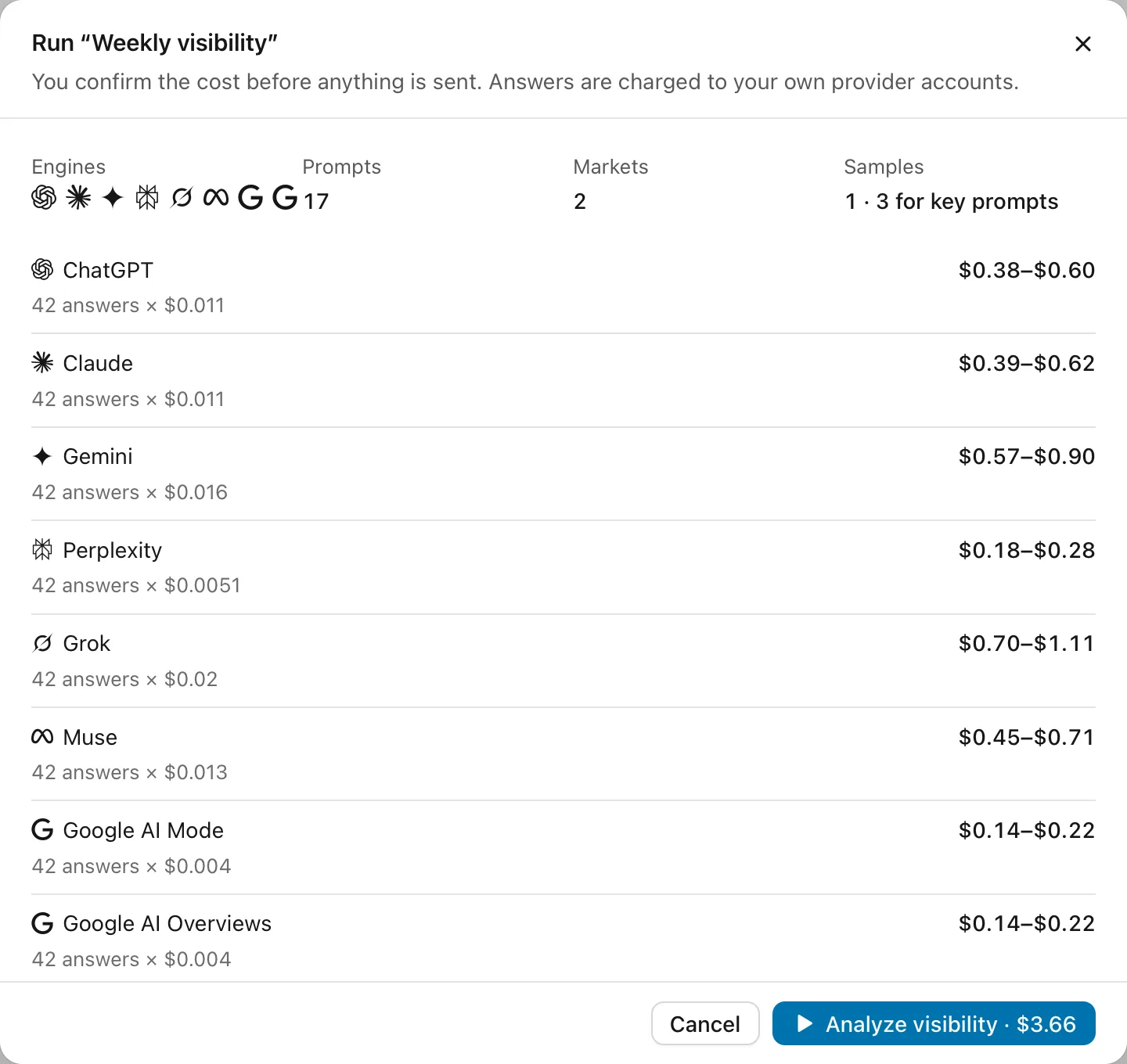
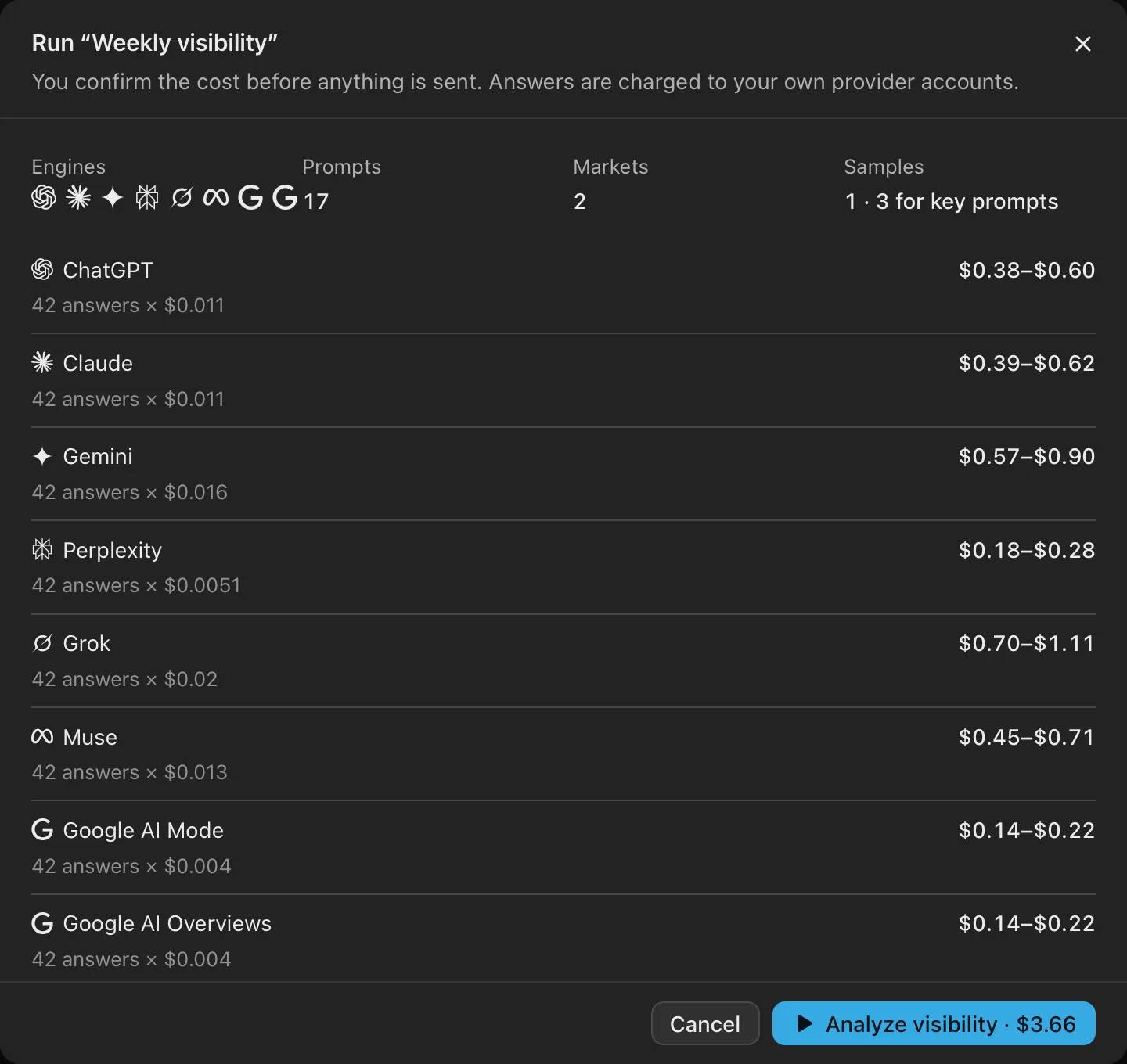
If you want a paid local app but not ours, Greta.sh's AI Visibility Tracker is the other one-time, bring-your-own-key desktop option; we compare the two in Surfacedd vs Greta.
How we checked
When Surfacedd is the wrong choice
Sources
Fair questions
Is there a free AI visibility tracker?
Yes, as software. Elmo, Limelit Open, GetCito, GEO/AEO Tracker, OneGlanse and Hearsay are free under MIT or Apache-2.0 licences. None of them makes the answers free: you pay AI providers' API fees or a scraping service per request, plus any hosting. For a small prompt set those fees are usually a few dollars a month. Your own time running and updating the tool is the larger cost.
Which open-source tracker is easiest to set up?
By its own description, Limelit Open: one downloaded binary on macOS or Linux, with a SQLite file and an embedded dashboard, and no Docker, Node or Postgres needed. Hearsay is also light, needing only Node 22.13 or later and no dependencies. Elmo, GetCito and OneGlanse need Docker or a hosted database and more setup.
Do open-source trackers use the API or the real ChatGPT website?
It varies. Hearsay and most of Limelit Open's targets use vendor APIs with web search. OneGlanse drives the real websites with your logins. GEO/AEO Tracker and some Elmo and Limelit targets buy scraped consumer answers from providers such as Bright Data or DataForSEO. API answers are stable and cheap but can differ from what users see; scraped answers are closer to the app but break more often.
Can I run an open-source tracker on Windows?
Mostly through Docker Desktop or WSL. The READMEs we read target macOS, Linux or Docker, and Limelit Open's quick start names macOS and Linux. Hearsay needs only Node 22.13 or later, and its README doesn't limit the operating system. If you want a native Windows app with an installer, Surfacedd ships through the Microsoft Store.
Are open-source trackers accurate?
They are as accurate as their sampling and counting rules, which you can read. That transparency is their main strength. Check whether the tool asks each prompt more than once and shows a range. Hearsay reports Wilson 95% intervals, and Elmo runs prompts several times a day. Without repeated samples, a single run can swing widely for no real reason.
Why would I pay for Surfacedd instead?
Only if the convenience is worth it to you. Surfacedd gives you an installer for Mac and Windows, keys in the system keychain, engine updates handled for you, eight surfaces, ranges, and audits and Humans in one app. It is a one-time licence, and you pay the same providers directly. If you enjoy running the stack yourself, open source does the core job without the licence.
How we research, write and correct pages: read our editorial policy.